Taxpayer First Act whistleblower protection: 180 days, double back pay
Verified against official sources:
For years the IRS whistleblower program had a hole in it: you could be paid for reporting tax fraud, but nothing in the tax code protected your job if your employer found out. The Taxpayer First Act closed that gap by adding an anti-retaliation provision, Section 7623(d) of the Internal Revenue Code, enforced by OSHA.
Who is covered
The TFA applies to any employer, and to any officer, employee, contractor, subcontractor, or agent of an employer. Unlike Sarbanes-Oxley, it is not limited to public companies. A bookkeeper at a family-owned business, a payroll clerk at a staffing agency, and a tax preparer at a private firm are all protected.
What is protected
You are protected for providing information regarding underpayment of tax, or any conduct you reasonably believe violates the internal revenue laws or any federal law relating to tax fraud, whether to the IRS, the Treasury Department, the Treasury Inspector General for Tax Administration, the Comptroller General, the Justice Department, Congress, or a person with supervisory authority over you. Testifying or assisting in IRS or Justice Department proceedings is also protected. OSHA’s chart notes that employees are protected from retaliation for certain complaints about pay misclassification under this Act, such as being treated as an independent contractor to avoid payroll taxes.
The 180-day deadline
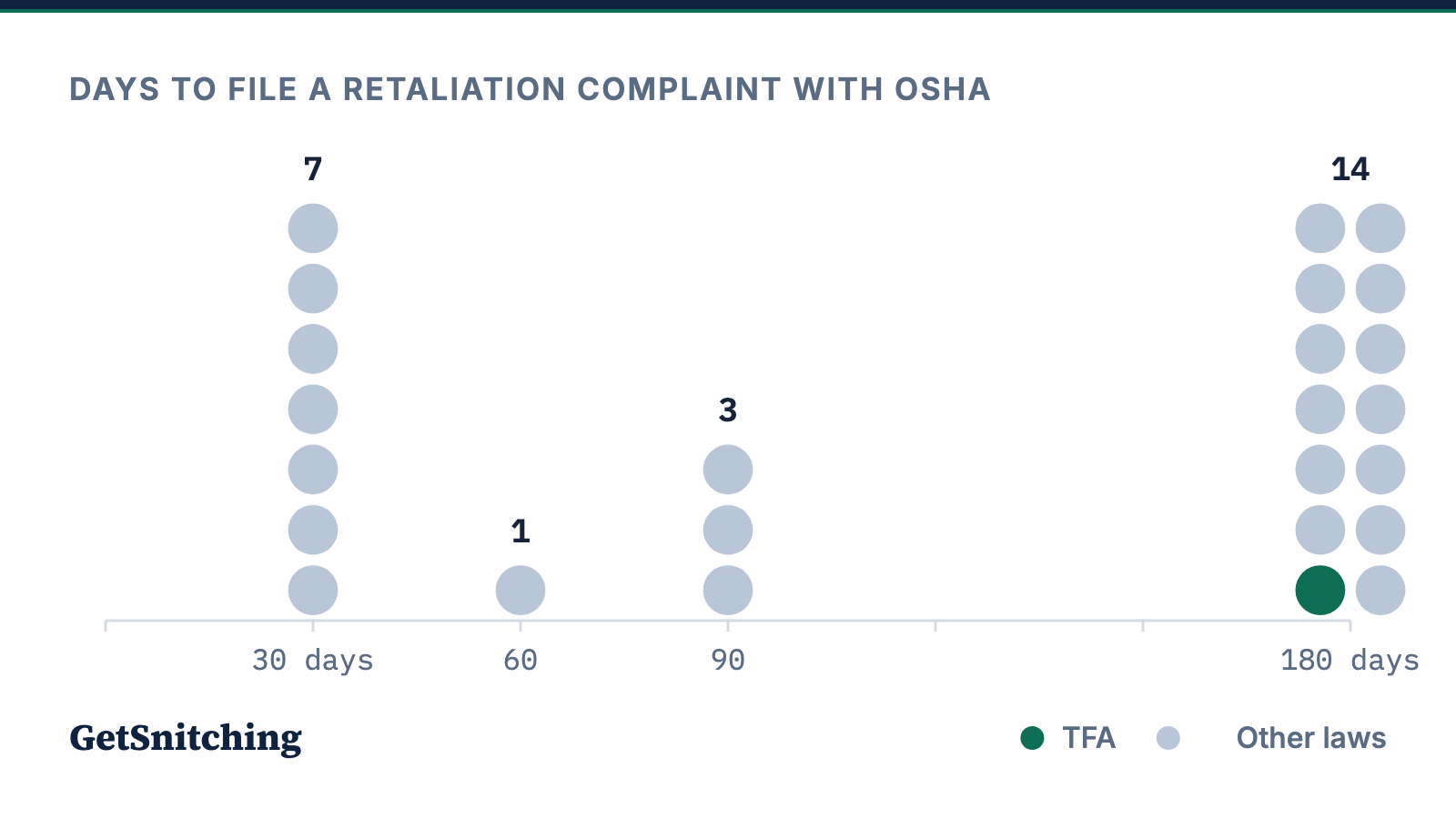
You have 180 days from the retaliatory act to file with OSHA. Filing a Form 211 with the IRS Whistleblower Office does not count as filing a retaliation complaint; the two processes are separate.
Remedies: among the strongest on the list
A successful complainant can recover reinstatement, 200 percent of back pay with interest, 100 percent of lost benefits, and compensatory damages including litigation costs, expert witness fees, and attorney’s fees. Only the TFA and the Anti-Money Laundering Act double back pay. Punitive damages are not available.
Procedure
The TFA uses the “contributing factor” causation standard. OSHA can order preliminary reinstatement. You can request findings after 60 days, and if there is no final Labor Department decision within 180 days of filing, and the delay is not your bad faith, you can bring the case in federal district court. Either party has 30 days to object to OSHA’s findings and request a hearing before an administrative law judge.
Pair it with the IRS reward
If the tax at issue is large enough, you may qualify for an award of 15 to 30 percent of collected proceeds under the IRS program. Our IRS whistleblower program page explains the thresholds, and the Form 211 guide walks through filing.
Other laws on the same 180-day clock
If your facts also touch one of these, the deadline is the same, but coverage and remedies differ.
- Affordable Care Act, Section 1558 (Fair Labor Standards Act Section 18C) (ACA)
- Criminal Antitrust Anti-Retaliation Act (CAARA)
- Consumer Financial Protection Act of 2010, Section 1057 (CFPA)
- Consumer Product Safety Improvement Act, Section 219 (CPSIA)
- Energy Reorganization Act of 1974, Section 211 (ERA)
- Federal Railroad Safety Act (FRSA)
- FDA Food Safety Modernization Act, Section 402 (FSMA)
- Moving Ahead for Progress in the 21st Century Act, Section 31307 (MAP-21)
- National Transit Systems Security Act (NTSSA)
- Pipeline Safety Improvement Act (PSIA)
- Sarbanes-Oxley Act of 2002, Section 806 (SOX)
- Seaman's Protection Act (SPA)
- Surface Transportation Assistance Act (STAA)
Related reading
Compare all 25 OSHA whistleblower laws
Not legal advice
GetSnitching explains programs and processes in plain English from official sources. Whistleblower and reporting decisions can carry real legal risk. For advice about your situation, talk to a licensed attorney. Many whistleblower attorneys offer free consultations.
Official sources
Cite this page