Energy Reorganization Act: nuclear industry whistleblower protection
Verified against official sources:
The nuclear industry runs on a safety culture that depends on workers raising problems early. Section 211 of the Energy Reorganization Act backs that up with a legal remedy: employees who report nuclear safety concerns are protected from retaliation, and OSHA investigates when they are not.
Who is covered
The ERA has one of the most detailed coverage lists of any statute OSHA enforces. It reaches licensees of the Nuclear Regulatory Commission or an Agreement State and applicants for those licenses, the contractors and subcontractors of those licensees and applicants, NRC contractors and subcontractors, and Department of Energy contractors and subcontractors that DOE indemnifies under the Atomic Energy Act. Work under the naval nuclear propulsion program (Executive Order 12344) is excluded. The NRC and DOE themselves are listed as employers, but OSHA’s chart notes that federal sovereign immunity bars claims against those agencies directly.
In practice this covers commercial reactor staff, fuel fabrication and enrichment workers, radiography and medical isotope licensees, decommissioning contractors, and the large workforce at DOE national laboratories and cleanup sites run by contractors.
Protected activity
You are protected for reporting violations of the Energy Reorganization Act, the Atomic Energy Act, or their regulations, whether to your employer or to the NRC or DOE, and for refusing to engage in practices that violate those laws, testifying, or assisting in proceedings. Raising a concern through your employer’s internal employee concerns program counts.
Deadline and procedure
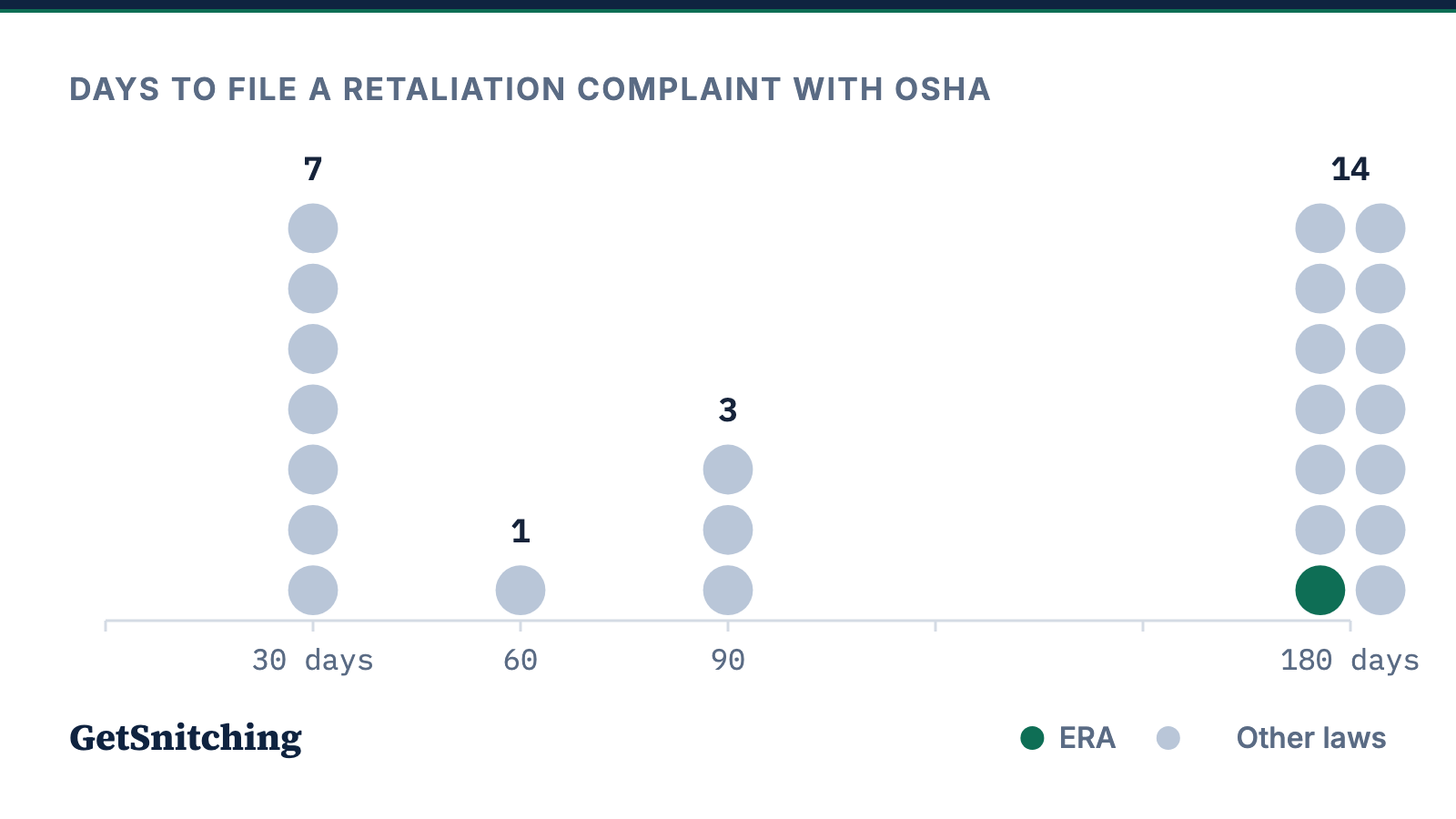
You have 180 days from the retaliatory act to file with OSHA. The ERA uses the “contributing factor” causation standard. You can request findings on the record after 30 days. OSHA’s chart shows that preliminary reinstatement is not available at the OSHA stage under the ERA. If the Labor Department has not issued a final decision within one year (365 days) of filing, and the delay is not due to your bad faith, you can take the case to federal district court; that kick-out period is the longest of any statute on OSHA’s list. After OSHA’s findings, either side has 30 days to request a hearing before an administrative law judge.
Remedies
Reinstatement, back pay, and compensatory damages, plus attorney’s fees and costs. Punitive damages are not available under the ERA.
Two channels, one problem
Nuclear safety concerns can also be raised directly with the NRC through its allegations program, which can investigate both the safety issue and whether you were retaliated against. That NRC process does not replace your OSHA complaint or stop the 180-day clock. Our retaliation protections guide explains how parallel channels interact, and the OSHA program page covers the filing itself.
Other laws on the same 180-day clock
If your facts also touch one of these, the deadline is the same, but coverage and remedies differ.
- Affordable Care Act, Section 1558 (Fair Labor Standards Act Section 18C) (ACA)
- Criminal Antitrust Anti-Retaliation Act (CAARA)
- Consumer Financial Protection Act of 2010, Section 1057 (CFPA)
- Consumer Product Safety Improvement Act, Section 219 (CPSIA)
- Federal Railroad Safety Act (FRSA)
- FDA Food Safety Modernization Act, Section 402 (FSMA)
- Moving Ahead for Progress in the 21st Century Act, Section 31307 (MAP-21)
- National Transit Systems Security Act (NTSSA)
- Pipeline Safety Improvement Act (PSIA)
- Sarbanes-Oxley Act of 2002, Section 806 (SOX)
- Seaman's Protection Act (SPA)
- Surface Transportation Assistance Act (STAA)
- Taxpayer First Act (TFA)
Related reading
Compare all 25 OSHA whistleblower laws
Not legal advice
GetSnitching explains programs and processes in plain English from official sources. Whistleblower and reporting decisions can carry real legal risk. For advice about your situation, talk to a licensed attorney. Many whistleblower attorneys offer free consultations.
Official sources
Cite this page