Pipeline Safety Improvement Act whistleblower protection: 180 days
Verified against official sources:
Pipeline failures are rare, but when they happen they are catastrophic: explosions in residential neighborhoods, crude oil in rivers. The people most likely to see the warning signs first are the employees and contractors who inspect, maintain, and operate pipelines. The Pipeline Safety Improvement Act protects them when they speak up.
Who is covered
PSIA reaches any person owning or operating pipeline facilities, including corporations, individuals, states, and municipalities, and their contractors and subcontractors. That includes interstate gas transmission companies, local gas distribution utilities (many of them municipal), hazardous liquid pipeline operators, and the inspection, integrity-management, and construction firms they hire.
Protected activity
You are protected for providing information relating to violations or alleged violations of federal pipeline safety law, whether to your employer or to the federal government, and for related conduct such as refusing to engage in practices made unlawful by those laws, testifying, and assisting in proceedings. Typical examples include reporting falsified inspection records, skipped integrity assessments, inadequate welding procedures, or ignored leak data.
The 180-day deadline
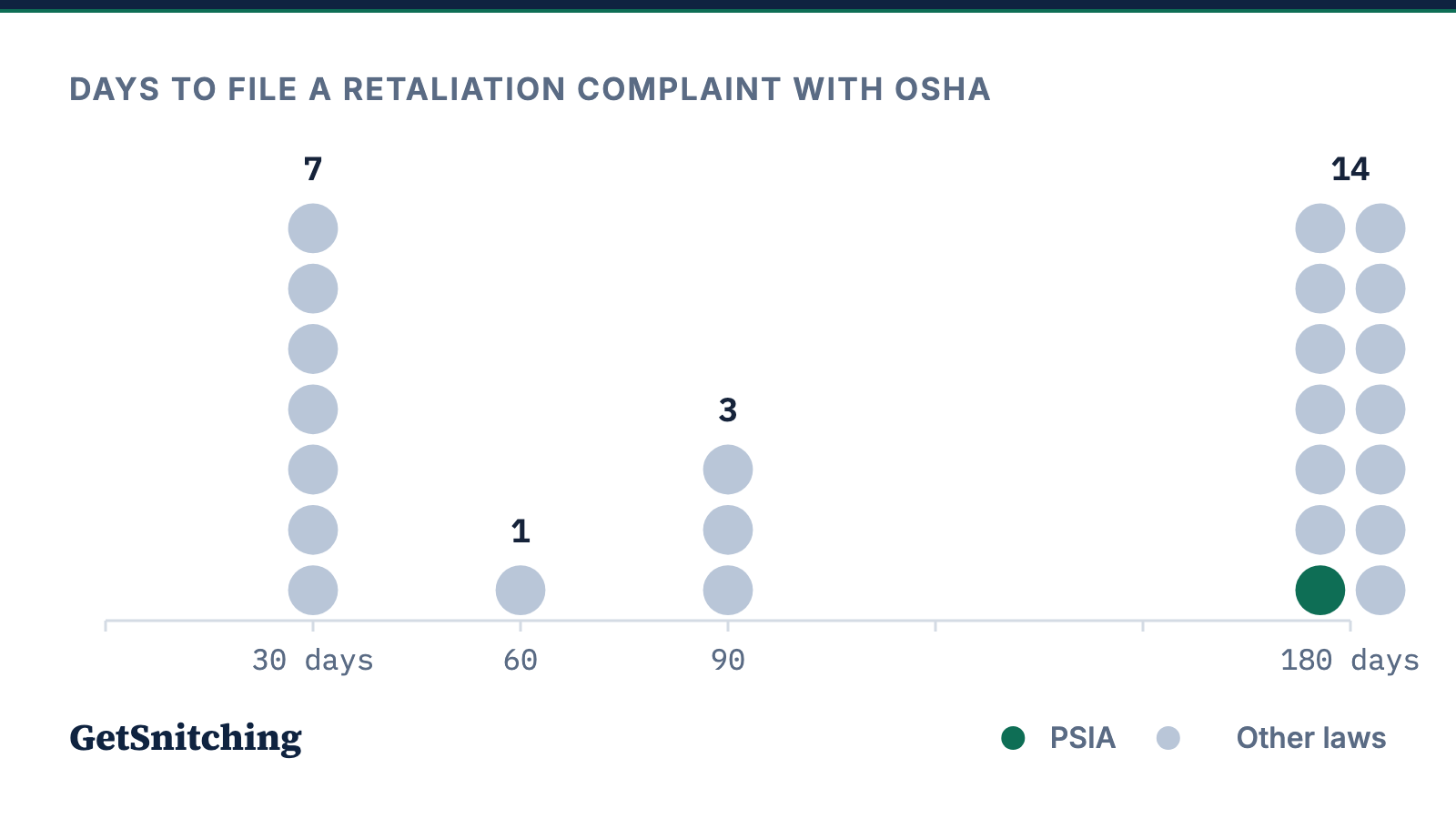
You have 180 days from the retaliatory act to file with OSHA.
A longer appeal window
PSIA has one distinctive procedural feature. After OSHA issues findings, the deadline to object and request a hearing before a Department of Labor administrative law judge is 60 days, double the 30 days that applies under every other statute heard by that office. OSHA’s chart lists PSIA as the only statute with this 60-day window.
Procedure and remedies
PSIA uses the “contributing factor” causation standard. OSHA can order preliminary reinstatement. You can request findings on the record after 60 days, and if there is no final Labor Department decision within 210 days of filing, you can bring the case in federal district court.
Remedies are reinstatement, back pay, and compensatory damages, plus attorney’s fees and costs. Punitive damages are not available.
Report the hazard
Pipeline safety violations can be reported to the Pipeline and Hazardous Materials Safety Administration (PHMSA). For an active leak or rupture, call 911 first. If your employer punishes you for reporting, our retaliation protections guide and the OSHA program page explain the next steps.
Other laws on the same 180-day clock
If your facts also touch one of these, the deadline is the same, but coverage and remedies differ.
- Affordable Care Act, Section 1558 (Fair Labor Standards Act Section 18C) (ACA)
- Criminal Antitrust Anti-Retaliation Act (CAARA)
- Consumer Financial Protection Act of 2010, Section 1057 (CFPA)
- Consumer Product Safety Improvement Act, Section 219 (CPSIA)
- Energy Reorganization Act of 1974, Section 211 (ERA)
- Federal Railroad Safety Act (FRSA)
- FDA Food Safety Modernization Act, Section 402 (FSMA)
- Moving Ahead for Progress in the 21st Century Act, Section 31307 (MAP-21)
- National Transit Systems Security Act (NTSSA)
- Sarbanes-Oxley Act of 2002, Section 806 (SOX)
- Seaman's Protection Act (SPA)
- Surface Transportation Assistance Act (STAA)
- Taxpayer First Act (TFA)
Related reading
Compare all 25 OSHA whistleblower laws
Not legal advice
GetSnitching explains programs and processes in plain English from official sources. Whistleblower and reporting decisions can carry real legal risk. For advice about your situation, talk to a licensed attorney. Many whistleblower attorneys offer free consultations.
Official sources
Cite this page