Sarbanes-Oxley whistleblower protection: 180 days to file with OSHA
Verified against official sources:
Sarbanes-Oxley’s whistleblower provision is the main federal retaliation remedy for employees of publicly traded companies who report fraud. It is the law behind many of the largest retaliation awards in corporate America, and it pairs naturally with the SEC whistleblower program: the SEC can pay you for the tip, and SOX protects your job.
Who is covered
SOX reaches public companies, meaning companies with securities registered under Section 12 of the Securities Exchange Act or required to file reports under Section 15(d), along with their consolidated subsidiaries and affiliates. It also covers nationally recognized statistical rating organizations, and the contractors, subcontractors, agents, officers, and employees of all of these. Private companies are not covered unless they fall into one of those categories, such as a contractor to a public company.
What is protected
You are protected for providing information about conduct you reasonably believe violates federal criminal mail, wire, bank, or securities fraud laws, any SEC rule or regulation, or any federal law relating to fraud against shareholders. Reporting to a federal agency, to Congress, or to a supervisor or someone with authority to investigate inside the company all count. You do not have to be right, and you do not have to cite the specific statute; your belief has to be reasonable.
The 180-day deadline
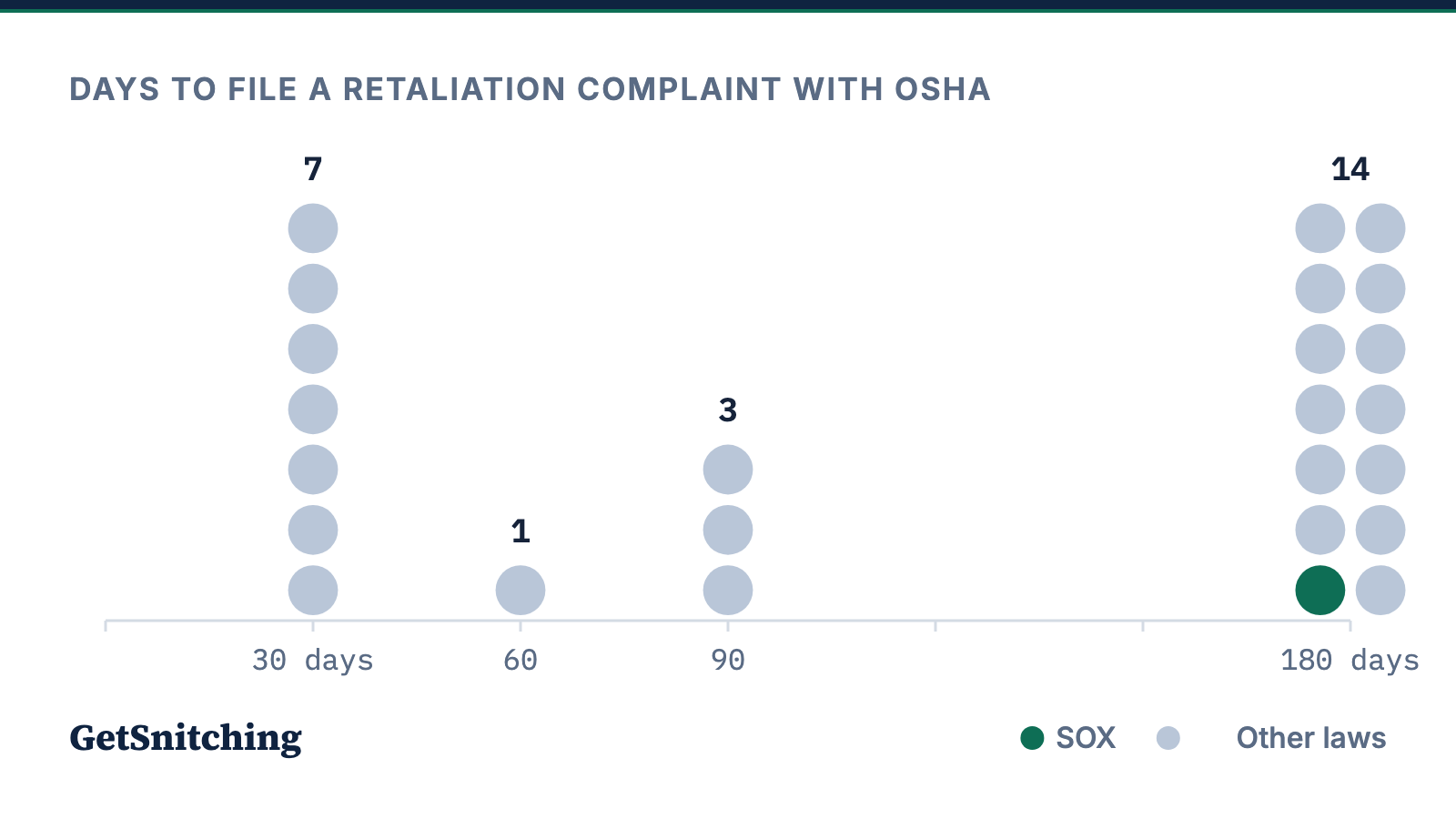
You have 180 days from the retaliatory act, or from when you became aware of it, to file with OSHA. Congress doubled the original 90-day window to 180 days in the Dodd-Frank Act.
Procedure
SOX uses the “contributing factor” causation standard. OSHA can order preliminary reinstatement if it finds merit. You can request findings after 60 days, and if there is no final Labor Department decision within 180 days of filing, and the delay is not your bad faith, you can take the case to federal district court for a jury trial. Either side has 30 days to object to OSHA’s findings and request a hearing before an administrative law judge.
Remedies
Reinstatement with the same seniority, back pay with interest, and special damages including litigation costs, expert witness fees, and attorney’s fees. Punitive damages are not available under SOX.
SOX versus Dodd-Frank
The Dodd-Frank Act created a separate anti-retaliation right that you can take straight to federal court, with different deadlines and double back pay, but the Supreme Court has held it applies only if you reported to the SEC before the retaliation. If you reported only internally, SOX is usually your main federal remedy. Our SEC whistleblower program page explains how the reward works, and the SEC process timeline shows how long it takes.
Other laws on the same 180-day clock
If your facts also touch one of these, the deadline is the same, but coverage and remedies differ.
- Affordable Care Act, Section 1558 (Fair Labor Standards Act Section 18C) (ACA)
- Criminal Antitrust Anti-Retaliation Act (CAARA)
- Consumer Financial Protection Act of 2010, Section 1057 (CFPA)
- Consumer Product Safety Improvement Act, Section 219 (CPSIA)
- Energy Reorganization Act of 1974, Section 211 (ERA)
- Federal Railroad Safety Act (FRSA)
- FDA Food Safety Modernization Act, Section 402 (FSMA)
- Moving Ahead for Progress in the 21st Century Act, Section 31307 (MAP-21)
- National Transit Systems Security Act (NTSSA)
- Pipeline Safety Improvement Act (PSIA)
- Seaman's Protection Act (SPA)
- Surface Transportation Assistance Act (STAA)
- Taxpayer First Act (TFA)
Related reading
Compare all 25 OSHA whistleblower laws
Not legal advice
GetSnitching explains programs and processes in plain English from official sources. Whistleblower and reporting decisions can carry real legal risk. For advice about your situation, talk to a licensed attorney. Many whistleblower attorneys offer free consultations.
Official sources
Cite this page