CFPA whistleblower protection: reporting consumer finance violations
Verified against official sources:
Section 1057 of the Consumer Financial Protection Act, part of the Dodd-Frank Act, protects employees of companies that sell consumer financial products when they report violations of consumer financial law. Think of the loan officer told to steer borrowers into costlier mortgages, the call center agent instructed to add products customers never agreed to, the debt collector pressured to use illegal tactics, or the fintech engineer who sees fees being disclosed one way and charged another.
Who is covered
The CFPA reaches any person, public or private sector, engaged in offering or providing a consumer financial product or service, along with certain affiliates and service providers. That includes banks, credit unions, mortgage lenders and servicers, payday and installment lenders, auto lenders, debt collectors, credit reporting companies, payment and money transfer apps, and the vendors that support them.
What is protected
Protected activity includes providing information about any violation of the CFPA, or of any other law, rule, order, regulation, or standard within the jurisdiction of the Consumer Financial Protection Bureau, whether you tell your employer, the CFPB, or another federal, state, or local authority. Testifying, filing, and objecting to or refusing to participate in conduct you reasonably believe is a violation are also covered.
The 180-day deadline
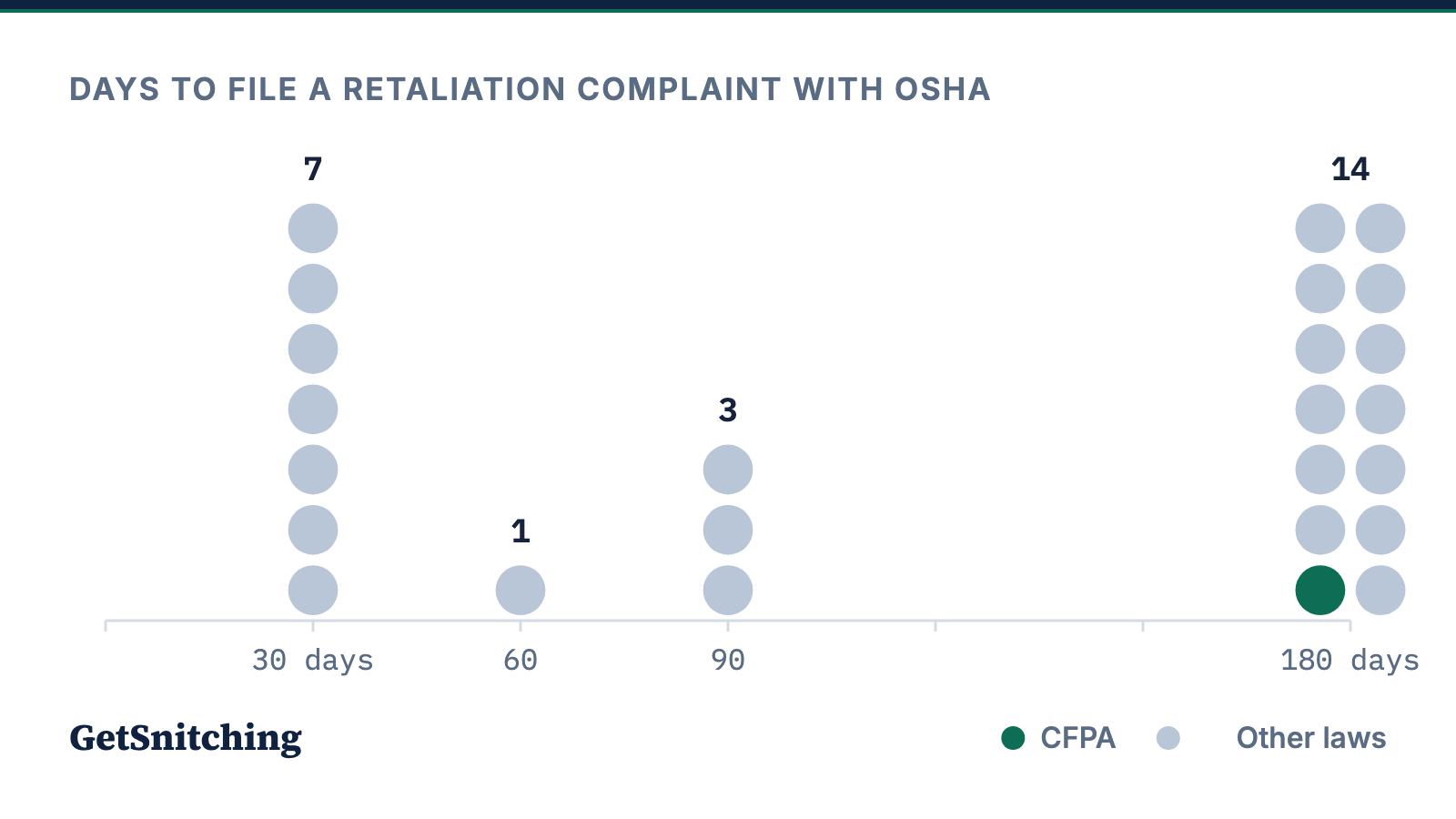
You have 180 days from the retaliatory act to file with OSHA, which handles CFPA retaliation claims even though the CFPB enforces the underlying law. Do not send your retaliation complaint only to the CFPB; it is a separate process from reporting the violation itself.
Procedure
The CFPA uses the “contributing factor” causation standard. OSHA can order preliminary reinstatement if it finds merit, and you can ask for findings on the record after 60 days. You can take the case to federal court if there is no final Labor Department decision within 210 days of filing, or within 90 days of OSHA’s findings; OSHA’s chart notes you may need to object to the findings to preserve the 90-day route. Either side has 30 days to object and request a hearing before an administrative law judge.
Remedies are reinstatement, back pay, and compensatory damages, plus fees and costs. Punitive damages are not available.
Rewards travel with some consumer-finance cases
The CFPB does not run a reward program. But if the misconduct also misled investors of a public company, the SEC whistleblower program pays 10 to 30 percent of sanctions over $1 million, and the Sarbanes-Oxley Act gives public-company employees a parallel retaliation claim. Fraud affecting federally insured financial institutions may also fit the FIRREA declarations program.
Other laws on the same 180-day clock
If your facts also touch one of these, the deadline is the same, but coverage and remedies differ.
- Affordable Care Act, Section 1558 (Fair Labor Standards Act Section 18C) (ACA)
- Criminal Antitrust Anti-Retaliation Act (CAARA)
- Consumer Product Safety Improvement Act, Section 219 (CPSIA)
- Energy Reorganization Act of 1974, Section 211 (ERA)
- Federal Railroad Safety Act (FRSA)
- FDA Food Safety Modernization Act, Section 402 (FSMA)
- Moving Ahead for Progress in the 21st Century Act, Section 31307 (MAP-21)
- National Transit Systems Security Act (NTSSA)
- Pipeline Safety Improvement Act (PSIA)
- Sarbanes-Oxley Act of 2002, Section 806 (SOX)
- Seaman's Protection Act (SPA)
- Surface Transportation Assistance Act (STAA)
- Taxpayer First Act (TFA)
Related reading
Compare all 25 OSHA whistleblower laws
Not legal advice
GetSnitching explains programs and processes in plain English from official sources. Whistleblower and reporting decisions can carry real legal risk. For advice about your situation, talk to a licensed attorney. Many whistleblower attorneys offer free consultations.
Official sources
Cite this page