FRSA railroad whistleblower protection: injuries, hazards, 180 days
Verified against official sources:
Railroad work is dangerous, and for decades the pressure not to report injuries was part of the culture: report an injury and you might find yourself charged with a rules violation for causing it. The Federal Railroad Safety Act’s whistleblower provision was strengthened specifically to stop that. It is one of the most frequently used statutes in OSHA’s program, and one of the strongest.
Who is covered
FRSA applies to railroad carriers and their contractors, subcontractors, officers, and employees. Conductors, engineers, track maintainers, signal workers, carmen, dispatchers, and contractor crews working on railroad property are all within its reach.
What is protected
FRSA protects a wide range of conduct. It covers reporting a work-related injury or illness, reporting a hazardous safety or security condition, reporting a violation of federal railroad safety or security law, and reporting fraud, waste, or abuse of public funds appropriated for railroad safety. It protects refusing to work when confronted with a hazardous safety or security condition, under conditions the statute spells out. And it does something no other statute on OSHA’s list does: it requires railroads to provide prompt medical attention when an injured employee requests it, and bars them from denying, delaying, or interfering with that care.
The 180-day deadline
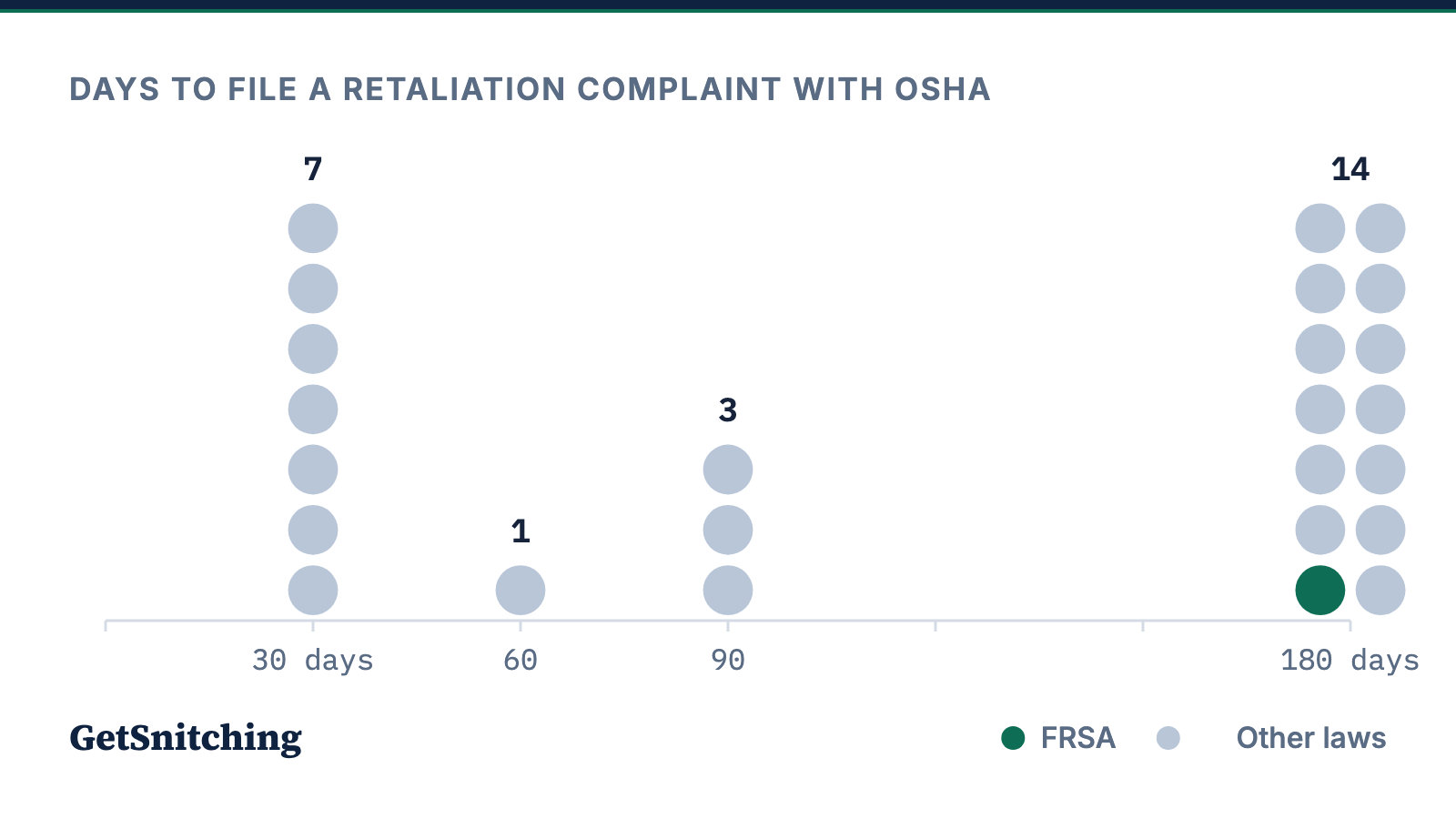
You have 180 days from the retaliatory act to file with OSHA. Many FRSA cases start with discipline after an injury report, so the adverse action may be a formal investigation hearing or a suspension. Count from the date you were told about the discipline, not the date of the injury.
Procedure
FRSA uses the “contributing factor” causation standard, so you need to show your protected activity was one factor in the decision; the railroad then has to prove by clear and convincing evidence it would have acted the same way anyway. OSHA can order preliminary reinstatement. You can request findings after 60 days, and if there is no final Labor Department decision within 210 days of filing, you can move the case to federal district court. Either side has 30 days to object to OSHA’s findings and request a hearing before an administrative law judge.
Remedies
FRSA is one of the few statutes that allows punitive damages, capped at $250,000, on top of reinstatement, back pay, and compensatory damages, plus fees and costs.
Next steps
If your railroad is also a federal contractor or receives federal safety funds, fraud in how those funds are spent can support a qui tam case. For the mechanics of filing, see our OSHA complaint guide.
Other laws on the same 180-day clock
If your facts also touch one of these, the deadline is the same, but coverage and remedies differ.
- Affordable Care Act, Section 1558 (Fair Labor Standards Act Section 18C) (ACA)
- Criminal Antitrust Anti-Retaliation Act (CAARA)
- Consumer Financial Protection Act of 2010, Section 1057 (CFPA)
- Consumer Product Safety Improvement Act, Section 219 (CPSIA)
- Energy Reorganization Act of 1974, Section 211 (ERA)
- FDA Food Safety Modernization Act, Section 402 (FSMA)
- Moving Ahead for Progress in the 21st Century Act, Section 31307 (MAP-21)
- National Transit Systems Security Act (NTSSA)
- Pipeline Safety Improvement Act (PSIA)
- Sarbanes-Oxley Act of 2002, Section 806 (SOX)
- Seaman's Protection Act (SPA)
- Surface Transportation Assistance Act (STAA)
- Taxpayer First Act (TFA)
Related reading
Compare all 25 OSHA whistleblower laws
Not legal advice
GetSnitching explains programs and processes in plain English from official sources. Whistleblower and reporting decisions can carry real legal risk. For advice about your situation, talk to a licensed attorney. Many whistleblower attorneys offer free consultations.
Official sources
Cite this page