NTSSA public transit whistleblower protection: 180 days, punitive damages
Verified against official sources:
Public transit workers are government employees in many cities, which leaves them outside some private-sector protections. The National Transit Systems Security Act fills that gap. It protects employees of public transportation agencies and their contractors who report safety and security problems, and it is the transit counterpart to the Federal Railroad Safety Act.
Who is covered
NTSSA applies to public transportation agencies, their officers and employees, and their contractors and subcontractors. Bus operators, subway and light-rail operators, mechanics, station agents, signal and track workers, and employees of contracted paratransit and maintenance firms are all covered.
Protected activity
The statute protects reporting a hazardous safety or security condition, reporting a violation of federal law relating to public transportation safety or security, and reporting fraud, waste, or abuse of federal grants or other public funds intended for public transportation safety or security. It also protects refusing to work when confronted with a hazardous safety or security condition, under the conditions the statute sets out, and cooperating with investigations.
The 180-day deadline
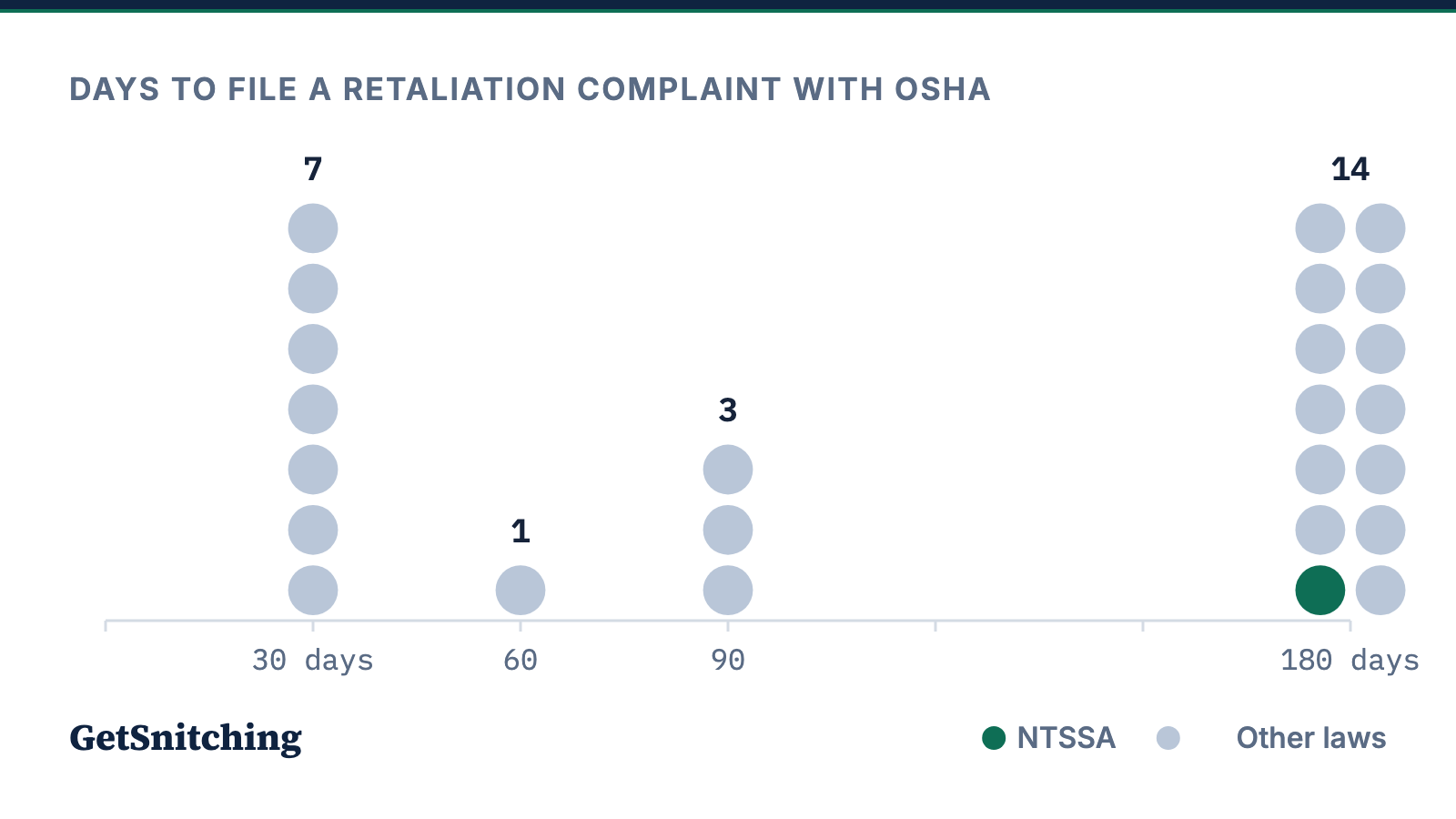
You have 180 days from the retaliatory act to file with OSHA. Transit agencies often have union grievance processes and civil service appeals. Those can run alongside your OSHA complaint, but they do not pause the 180-day clock.
Procedure
NTSSA uses the “contributing factor” causation standard. OSHA can order preliminary reinstatement. You can ask for findings after 60 days, and if the Labor Department has not issued a final decision within 210 days of filing, you can go to federal district court. Either side has 30 days to object to OSHA’s findings and request a hearing before an administrative law judge.
Remedies
NTSSA is one of a handful of statutes that allows punitive damages, capped at $250,000, in addition to reinstatement, back pay, compensatory damages, and attorney’s fees.
Misused transit funds can pay a reward
Transit agencies receive large federal grants. If you are reporting fraud in how those grant dollars were spent, such as billing for maintenance never performed or falsified safety certifications on a federally funded project, the False Claims Act may let you file a qui tam suit and share in the recovery. Railroad workers outside public transit should look at FRSA instead.
Other laws on the same 180-day clock
If your facts also touch one of these, the deadline is the same, but coverage and remedies differ.
- Affordable Care Act, Section 1558 (Fair Labor Standards Act Section 18C) (ACA)
- Criminal Antitrust Anti-Retaliation Act (CAARA)
- Consumer Financial Protection Act of 2010, Section 1057 (CFPA)
- Consumer Product Safety Improvement Act, Section 219 (CPSIA)
- Energy Reorganization Act of 1974, Section 211 (ERA)
- Federal Railroad Safety Act (FRSA)
- FDA Food Safety Modernization Act, Section 402 (FSMA)
- Moving Ahead for Progress in the 21st Century Act, Section 31307 (MAP-21)
- Pipeline Safety Improvement Act (PSIA)
- Sarbanes-Oxley Act of 2002, Section 806 (SOX)
- Seaman's Protection Act (SPA)
- Surface Transportation Assistance Act (STAA)
- Taxpayer First Act (TFA)
Related reading
Compare all 25 OSHA whistleblower laws
Not legal advice
GetSnitching explains programs and processes in plain English from official sources. Whistleblower and reporting decisions can carry real legal risk. For advice about your situation, talk to a licensed attorney. Many whistleblower attorneys offer free consultations.
Official sources
Cite this page