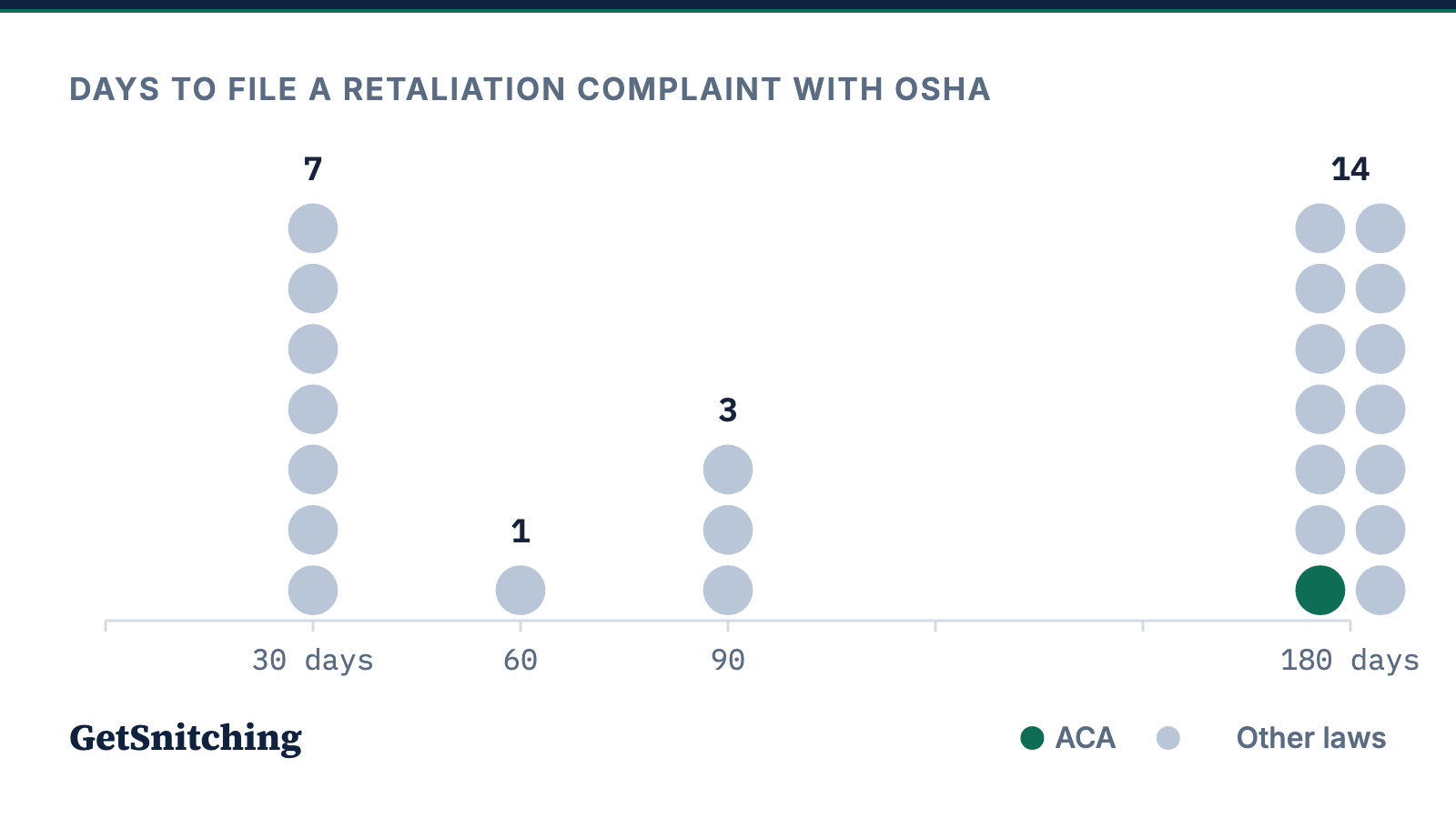
ACA whistleblower protection (Section 1558): 180 days to file
Verified against official sources:
The Affordable Care Act’s whistleblower provision is one of the least known laws OSHA enforces, and it protects two very different groups of people. The first is the insurance-industry employee who reports a violation of Title I of the ACA, the part that contains the health insurance market reforms: coverage of pre-existing conditions, bans on lifetime limits, dependent coverage to age 26, and similar rules. The second group is far larger and usually has no idea the protection exists: any employee whose employer retaliates against them because they received a premium tax credit or a cost-sharing reduction when buying coverage through a Marketplace.
Why the second group matters
Under the ACA, an employee getting a Marketplace subsidy can trigger an assessment against certain large employers that did not offer affordable coverage. Some employers have responded by punishing the worker. Section 1558 makes that retaliation illegal, and it applies to private and public sector employers alike, which is wider employer coverage than most laws on this list.
The deadline
You have 180 days from the retaliatory act to file with OSHA. That is the longest standard window OSHA offers, but do not let it lull you: evidence and witnesses fade, and the clock runs from the act, not from when you learn the law exists.
How the case moves
ACA complaints are handled under the modern procedural rules OSHA applies to most newer statutes. The causation standard is “contributing factor,” meaning you only have to show your protected activity was one factor in the decision, after which the burden shifts to the employer to prove by clear and convincing evidence it would have acted anyway. If OSHA finds merit, it can order preliminary reinstatement while the case continues.
The law also gives you a kick-out right. If the Department of Labor has not issued a final decision within 210 days of your filing, or within 90 days of OSHA’s findings, you can take the case to federal district court for a fresh hearing. OSHA’s chart warns that to use the 90-day route you may need to file objections to OSHA’s findings first to preserve it. After OSHA issues findings, either side has 30 days to object and request a hearing before a Department of Labor administrative law judge.
Remedies
Available remedies are reinstatement, back pay, and compensatory damages, plus costs and attorney’s fees. Punitive damages are not available under this statute.
What it does not cover
Section 1558 is an anti-retaliation law. It does not pay a reward for reporting insurance fraud. If the underlying conduct is an insurer or provider overbilling Medicare, Medicaid, or a federal subsidy program, look at the qui tam False Claims Act program, which pays relators a share of what the government recovers. For a broader map of how anti-retaliation laws fit together, see our guide to retaliation protections.
Other laws on the same 180-day clock
If your facts also touch one of these, the deadline is the same, but coverage and remedies differ.
- Criminal Antitrust Anti-Retaliation Act (CAARA)
- Consumer Financial Protection Act of 2010, Section 1057 (CFPA)
- Consumer Product Safety Improvement Act, Section 219 (CPSIA)
- Energy Reorganization Act of 1974, Section 211 (ERA)
- Federal Railroad Safety Act (FRSA)
- FDA Food Safety Modernization Act, Section 402 (FSMA)
- Moving Ahead for Progress in the 21st Century Act, Section 31307 (MAP-21)
- National Transit Systems Security Act (NTSSA)
- Pipeline Safety Improvement Act (PSIA)
- Sarbanes-Oxley Act of 2002, Section 806 (SOX)
- Seaman's Protection Act (SPA)
- Surface Transportation Assistance Act (STAA)
- Taxpayer First Act (TFA)
Related reading
Compare all 25 OSHA whistleblower laws
Not legal advice
GetSnitching explains programs and processes in plain English from official sources. Whistleblower and reporting decisions can carry real legal risk. For advice about your situation, talk to a licensed attorney. Many whistleblower attorneys offer free consultations.
Official sources
Cite this page