CAARA: whistleblower protection for reporting price-fixing and bid-rigging
Verified against official sources:
Cartels depend on silence. Price-fixing, bid-rigging, and customer or market allocation schemes are usually run by a handful of executives, and the employees who notice them, the sales rep asked to submit a deliberately losing bid, the analyst who sees identical price moves coordinated with a competitor, are exactly the people most exposed to retaliation. The Criminal Antitrust Anti-Retaliation Act gives those employees a federal remedy enforced by OSHA.
What it protects
CAARA protects employees who report violations of the criminal antitrust laws, which the statute defines as Sections 1 and 3 of the Sherman Act. It also protects reports of other criminal laws violated in conjunction with a potential antitrust violation, and participation in a Department of Justice investigation of potential criminal antitrust violations. Reporting to the federal government, or to a supervisor or someone with authority to investigate inside your company, both count.
Coverage is broad on the employer side: any person, including corporations, associations, and state and local government entities, along with any officer, employee, contractor, subcontractor, or agent of such a person.
The 180-day deadline
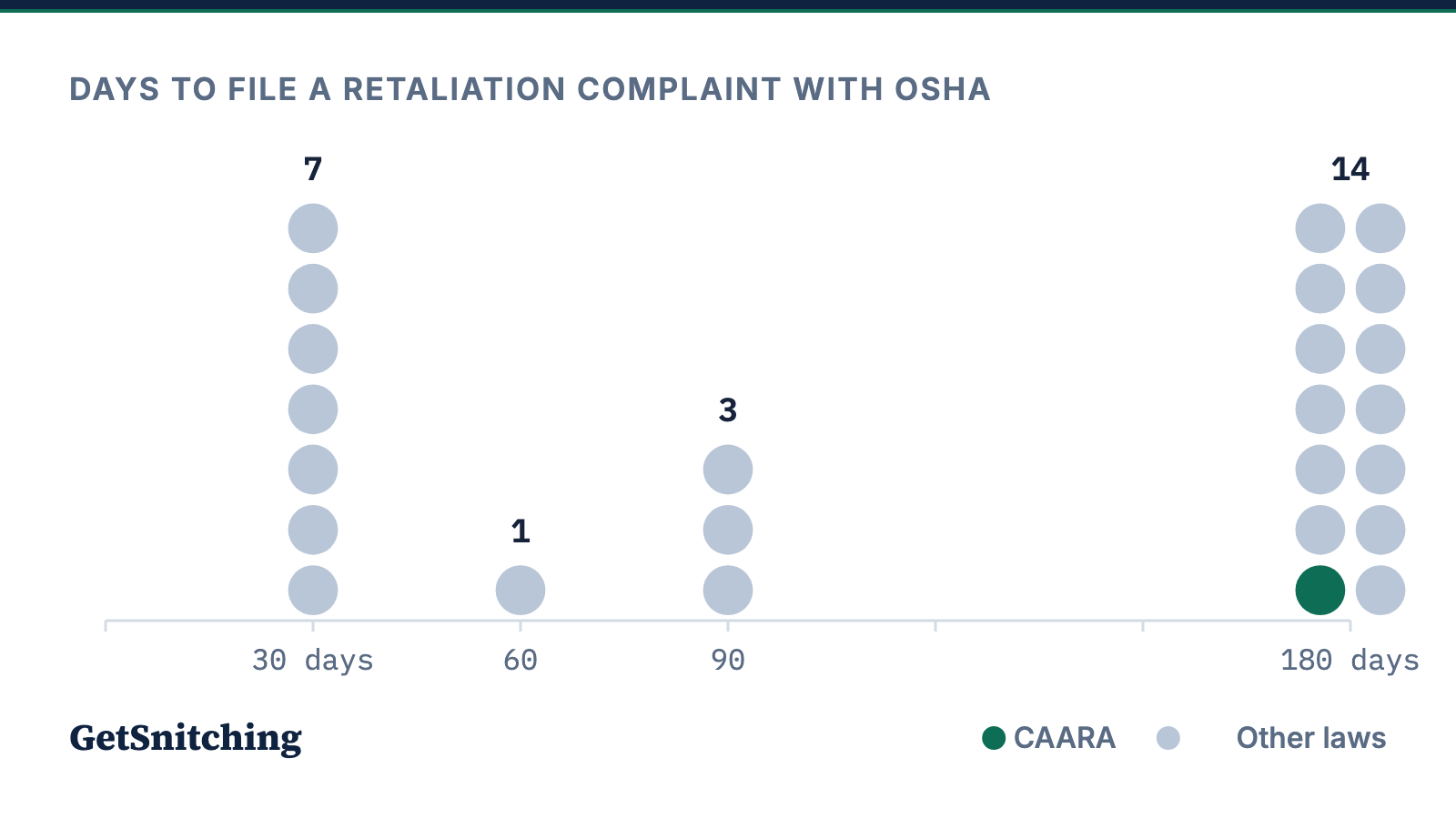
You have 180 days from the retaliatory act to file with OSHA. That is generous by OSHA standards, but the conduct CAARA covers is usually tied to a larger investigation, and timing decisions about when to come forward are often made with a lawyer who is also thinking about leniency and cooperation. Do not let strategy discussions run past your filing deadline.
Procedure and remedies
CAARA uses the “contributing factor” causation standard. OSHA can order preliminary reinstatement if it finds merit. You can ask OSHA for findings on the record after 60 days, and if there is no final Labor Department decision within 180 days of filing, and the delay is not your fault, you can take the case to federal district court. Either side has 30 days to object to OSHA’s findings and go before an administrative law judge.
Remedies include reinstatement, back pay with interest, and compensatory damages including attorney’s fees and costs. Punitive damages are not available.
One limit worth knowing
CAARA does not protect an employee who planned and initiated the antitrust violation, or who planned and initiated an obstruction of the related investigation. If you were involved in the scheme, get independent counsel before you report.
Is there a reward?
CAARA itself pays nothing. But bid-rigging on government contracts is classic False Claims Act territory, where a relator can share 15 to 30 percent of what the government recovers. For a broader view of how retaliation laws fit together, see our retaliation protections guide.
Other laws on the same 180-day clock
If your facts also touch one of these, the deadline is the same, but coverage and remedies differ.
- Affordable Care Act, Section 1558 (Fair Labor Standards Act Section 18C) (ACA)
- Consumer Financial Protection Act of 2010, Section 1057 (CFPA)
- Consumer Product Safety Improvement Act, Section 219 (CPSIA)
- Energy Reorganization Act of 1974, Section 211 (ERA)
- Federal Railroad Safety Act (FRSA)
- FDA Food Safety Modernization Act, Section 402 (FSMA)
- Moving Ahead for Progress in the 21st Century Act, Section 31307 (MAP-21)
- National Transit Systems Security Act (NTSSA)
- Pipeline Safety Improvement Act (PSIA)
- Sarbanes-Oxley Act of 2002, Section 806 (SOX)
- Seaman's Protection Act (SPA)
- Surface Transportation Assistance Act (STAA)
- Taxpayer First Act (TFA)
Related reading
Compare all 25 OSHA whistleblower laws
Not legal advice
GetSnitching explains programs and processes in plain English from official sources. Whistleblower and reporting decisions can carry real legal risk. For advice about your situation, talk to a licensed attorney. Many whistleblower attorneys offer free consultations.
Official sources
Cite this page