FSMA food safety whistleblower protection: 180 days to file
Verified against official sources:
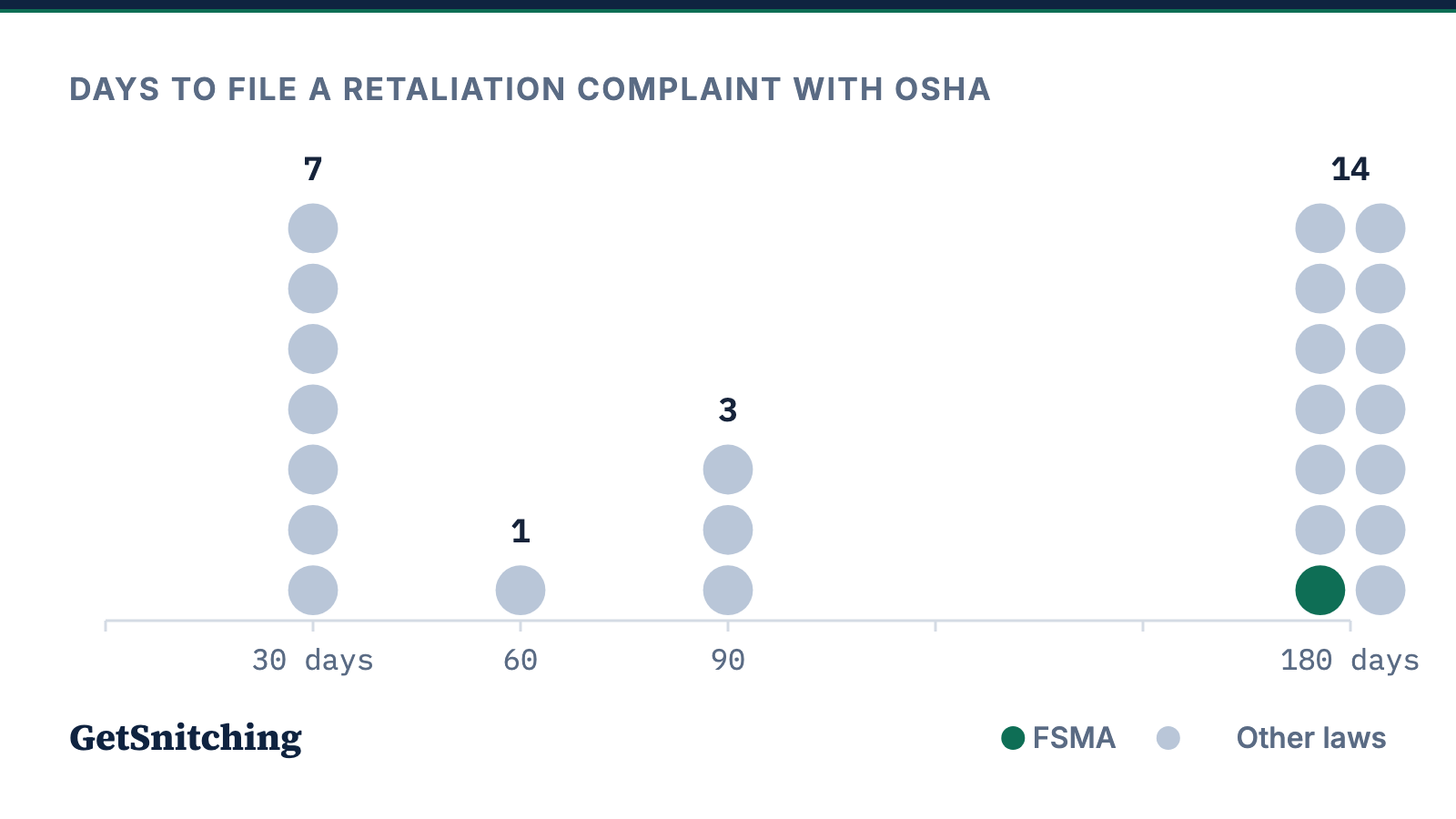
The Food Safety Modernization Act covers more workers than almost any other whistleblower law OSHA enforces, and most of them have never heard of it. If you work anywhere in the food chain, from a farm or packing house to a delivery truck, a warehouse, a grocery store, or a restaurant kitchen, and you were punished for raising a food safety concern, FSMA is likely on your side.
Who is covered
The statute applies to entities engaged in the manufacture, processing, packing, transportation, distribution, reception, holding, or importation of food. OSHA’s chart is explicit that this includes restaurants, grocery stores, other retail food establishments, farms, food testing laboratories, and food safety inspection services. A line cook who refused to serve spoiled product, a plant sanitation worker who flagged a Listeria problem, and a lab technician who would not falsify test results are all examples of people FSMA protects.
What is protected
Protected activity includes providing information about any violation, or any conduct you reasonably believe is a violation, of the Federal Food, Drug, and Cosmetic Act, whether you report to your employer, the FDA, or a state agency. Testifying, assisting in proceedings, and objecting to or refusing to participate in conduct you reasonably believe violates the Act are also covered.
The 180-day deadline
You have 180 days from the retaliatory act to file with OSHA. Food-industry employers often have high turnover and informal discipline, such as cut hours or schedule changes rather than formal termination. Those count as adverse actions too, and the clock starts when they happen.
Procedure and remedies
FSMA uses the “contributing factor” causation standard. OSHA can order preliminary reinstatement if it finds merit. You can ask for findings after 60 days, and you can take the case to federal court if there is no final Labor Department decision within 210 days of filing, or within 90 days of OSHA’s findings (OSHA’s chart warns that objecting to the findings may be needed to preserve the 90-day route). Either side has 30 days to object and request a hearing before an administrative law judge.
Remedies are reinstatement, back pay, and compensatory damages, plus attorney’s fees and costs. Punitive damages are not available.
Report the hazard
You can report a food safety problem to the FDA’s consumer complaint coordinator for your state, or to your state or local health department for restaurants. Neither pays a reward. If the company sells food to federal programs such as school lunch or military supply and hid a safety failure, that can support a False Claims Act case, which does pay relators. The OSHA program page explains the retaliation filing itself.
Other laws on the same 180-day clock
If your facts also touch one of these, the deadline is the same, but coverage and remedies differ.
- Affordable Care Act, Section 1558 (Fair Labor Standards Act Section 18C) (ACA)
- Criminal Antitrust Anti-Retaliation Act (CAARA)
- Consumer Financial Protection Act of 2010, Section 1057 (CFPA)
- Consumer Product Safety Improvement Act, Section 219 (CPSIA)
- Energy Reorganization Act of 1974, Section 211 (ERA)
- Federal Railroad Safety Act (FRSA)
- Moving Ahead for Progress in the 21st Century Act, Section 31307 (MAP-21)
- National Transit Systems Security Act (NTSSA)
- Pipeline Safety Improvement Act (PSIA)
- Sarbanes-Oxley Act of 2002, Section 806 (SOX)
- Seaman's Protection Act (SPA)
- Surface Transportation Assistance Act (STAA)
- Taxpayer First Act (TFA)
Related reading
Compare all 25 OSHA whistleblower laws
Not legal advice
GetSnitching explains programs and processes in plain English from official sources. Whistleblower and reporting decisions can carry real legal risk. For advice about your situation, talk to a licensed attorney. Many whistleblower attorneys offer free consultations.
Official sources
Cite this page