OSH Act Section 11(c): the 30-day workplace safety retaliation law
Verified against official sources:
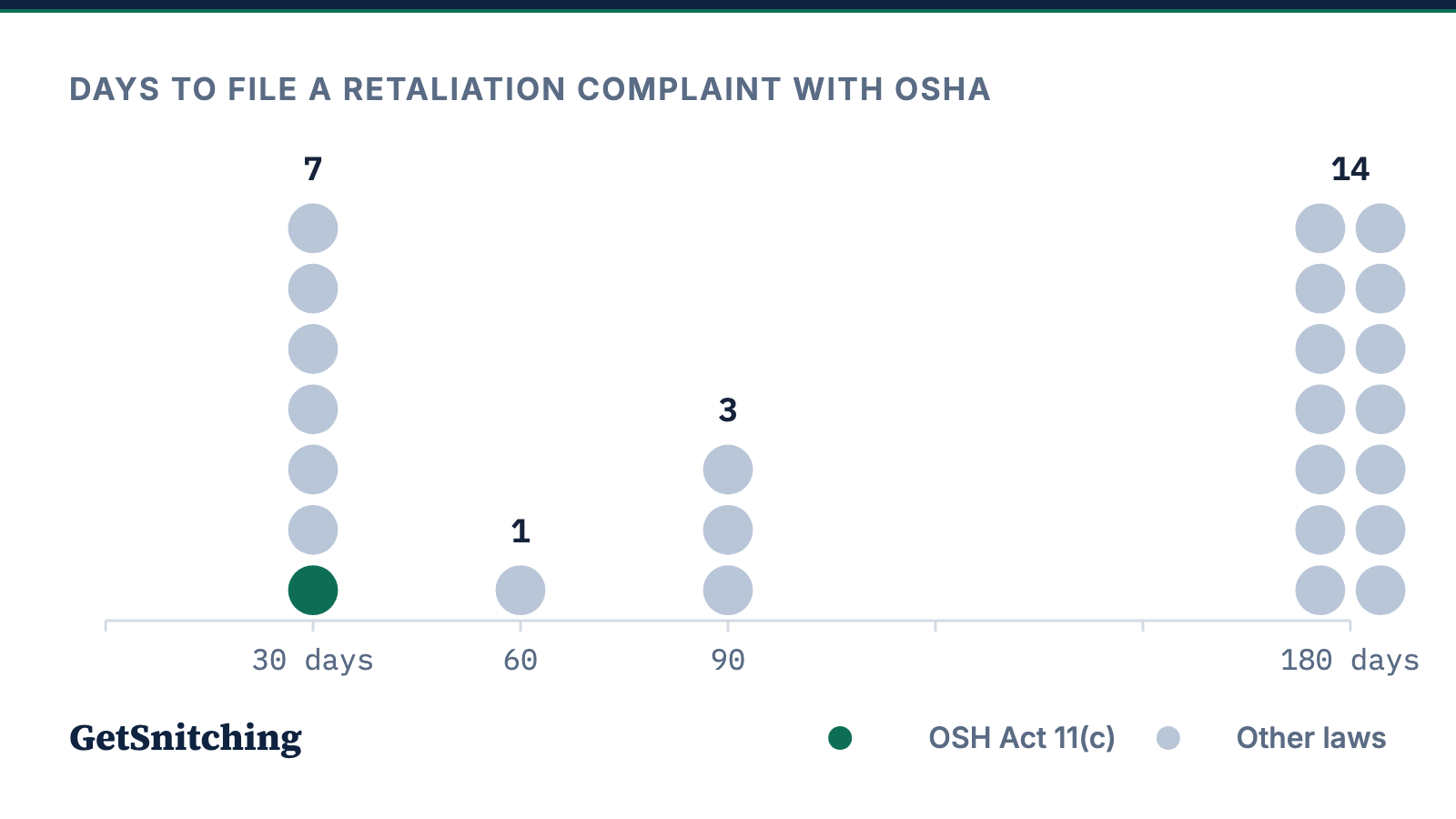
Section 11(c) is the oldest and most widely used of the 25 whistleblower laws OSHA enforces, and it is the one that applies to most ordinary jobs. If you complained about a safety hazard, called OSHA, told a manager a machine was unguarded, or reported a work-related injury, and your employer then fired you, cut your hours, moved you to a worse shift, or disciplined you, Section 11(c) is very likely the law that protects you. It is also the law with the least forgiving terms on the list, which is why it deserves a page of its own.
The 30-day clock
You have 30 calendar days from the retaliatory act to file. Not 30 days from when you found a lawyer, and not 30 days from when you decided the firing was unfair. The clock usually starts on the day you were told about the adverse action. OSHA’s chart notes there are limited circumstances in which a deadline can be extended, but they are narrow and you should not plan around them. If you are inside the window today, file today; a complaint can be made by phone at 1-800-321-OSHA, online, or in person at any OSHA area office, and it can be oral.
Who it covers
Section 11(c) reaches private-sector employers of every size, the U.S. Postal Service, and tribal commercial enterprises (with some circuit-court exceptions OSHA flags in its chart). It does not reach federal agencies other than the Postal Service, and it does not reach state and local government employers directly. In the 21 states (plus Puerto Rico) that run their own OSHA-approved State Plans for private employers, a parallel state retaliation law usually applies too, often with its own deadline, and public employees in those states may be covered only by the state version.
What counts as protected activity
The protected acts are broad: filing a safety or health complaint with OSHA, another agency, or your own management; participating in an inspection or proceeding; testifying; and reporting a work-related injury or illness. You do not have to be right that a hazard existed. You do have to be raising a genuine safety or health concern.
Remedies, and the two weaknesses
If OSHA finds merit, available remedies include reinstatement, back pay, compensatory damages, and punitive damages. Two features make 11(c) weaker than the newer laws on this list. First, the causation standard is “but for”: you have to show the employer would not have acted but for your protected activity, a harder test than the “contributing factor” standard used by Sarbanes-Oxley or STAA. Second, there is no private right of action and no kick-out to federal court. OSHA cannot order preliminary reinstatement itself; it has to go to a federal district court on your behalf. If OSHA dismisses your complaint, your only route is a request for review within 15 days.
Check for a stronger statute
Because 11(c) is the weakest tool, always ask whether your facts also fit a more specific law. A truck driver who refused to drive an unsafe rig has STAA, with 180 days and a contributing-factor test. A railroad worker has FRSA. A nuclear plant worker has the Energy Reorganization Act. File under every law that plausibly applies, but hit the 30-day 11(c) deadline first. Our OSHA complaint guide walks through the filing itself, and the full OSHA program page covers what an investigation looks like.
Other laws on the same 30-day clock
If your facts also touch one of these, the deadline is the same, but coverage and remedies differ.
Related reading
Compare all 25 OSHA whistleblower laws
Not legal advice
GetSnitching explains programs and processes in plain English from official sources. Whistleblower and reporting decisions can carry real legal risk. For advice about your situation, talk to a licensed attorney. Many whistleblower attorneys offer free consultations.
Official sources
Cite this page