Clean Water Act whistleblower protection: 30 days to file with OSHA
Verified against official sources:
The Clean Water Act, formally the Federal Water Pollution Control Act, regulates discharges of pollutants into the waters of the United States. It also governs water quality standards for surface waters, municipal wastewater treatment systems, and certain vessel discharges. Employees who report violations, such as an operator told to bypass a treatment system, a technician asked to fudge discharge monitoring reports, or a plant worker who sees waste dumped into a storm drain, are protected from retaliation under the Act’s whistleblower provision.
The 30-day deadline
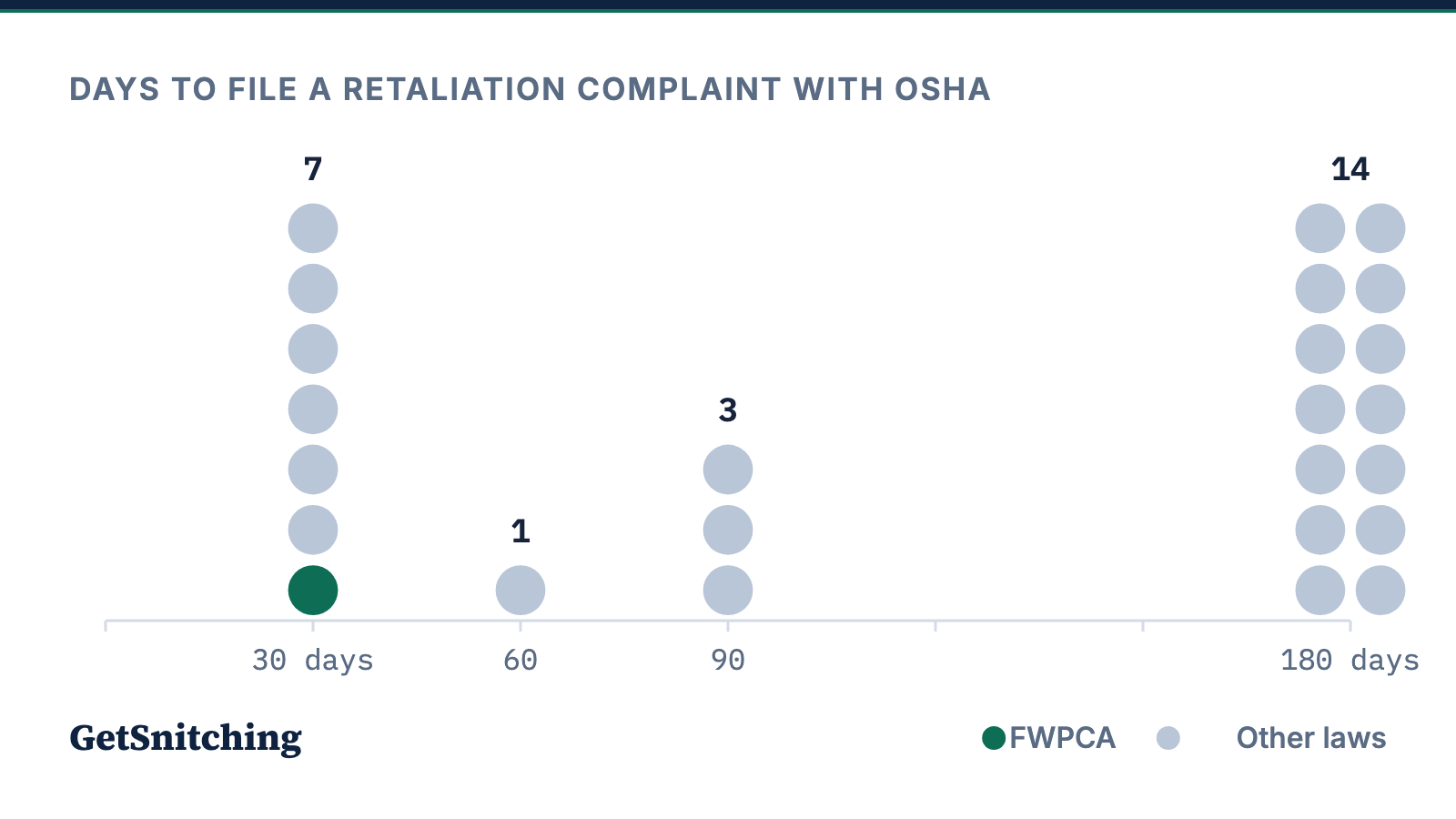
Like the other pollution statutes, the Clean Water Act gives you only 30 days from the retaliatory act to file with OSHA. This is the single most important fact on this page. A strong case filed on day 31 is usually lost.
Who is covered, and the federal gap
The Clean Water Act applies to persons generally, so private companies and municipalities are covered. But OSHA’s environmental desk aid explains that, unlike the Clean Air Act, CERCLA, the Safe Drinking Water Act, and RCRA, the Clean Water Act does not waive federal sovereign immunity. A federal agency employee who reports water pollution generally cannot bring a Clean Water Act retaliation claim against the federal government and needs to look at other federal-employee protections instead.
The Act does protect an authorized representative of employees, such as a union representative, in addition to employees themselves, a feature it shares with CERCLA and RCRA.
Protected activity and causation
You are protected for reporting potential violations relating to the discharge of pollutants into U.S. waters, to your employer or to EPA or a state water agency, and for testifying or participating in proceedings under the Act. The causation standard is “motivating factor.”
Procedure and remedies
OSHA investigates; you can request findings on the record after 30 days, and either side has 30 days after OSHA’s findings to request a hearing before a Department of Labor administrative law judge. There is no right to move the case to federal court, and OSHA cannot order preliminary reinstatement under the Clean Water Act. Remedies are reinstatement, back pay, and compensatory damages, plus fees and costs. Punitive damages are not available.
No bounty
Unlike the Clean Air Act and CERCLA, the Clean Water Act carries no $10,000 informant award provision. Our EPA whistleblower page explains how to report the underlying violation through EPA’s ECHO portal, and the OSHA program page covers the retaliation filing.
Other laws on the same 30-day clock
If your facts also touch one of these, the deadline is the same, but coverage and remedies differ.
- Clean Air Act (CAA)
- Comprehensive Environmental Response, Compensation, and Liability Act (CERCLA)
- Section 11(c) of the Occupational Safety and Health Act (OSH Act 11(c))
- Safe Drinking Water Act (SDWA)
- Solid Waste Disposal Act (Resource Conservation and Recovery Act) (SWDA)
- Toxic Substances Control Act (TSCA)
Related reading
Compare all 25 OSHA whistleblower laws
Not legal advice
GetSnitching explains programs and processes in plain English from official sources. Whistleblower and reporting decisions can carry real legal risk. For advice about your situation, talk to a licensed attorney. Many whistleblower attorneys offer free consultations.
Official sources
Cite this page