Clean Air Act whistleblower protection: only 30 days to file
Verified against official sources:
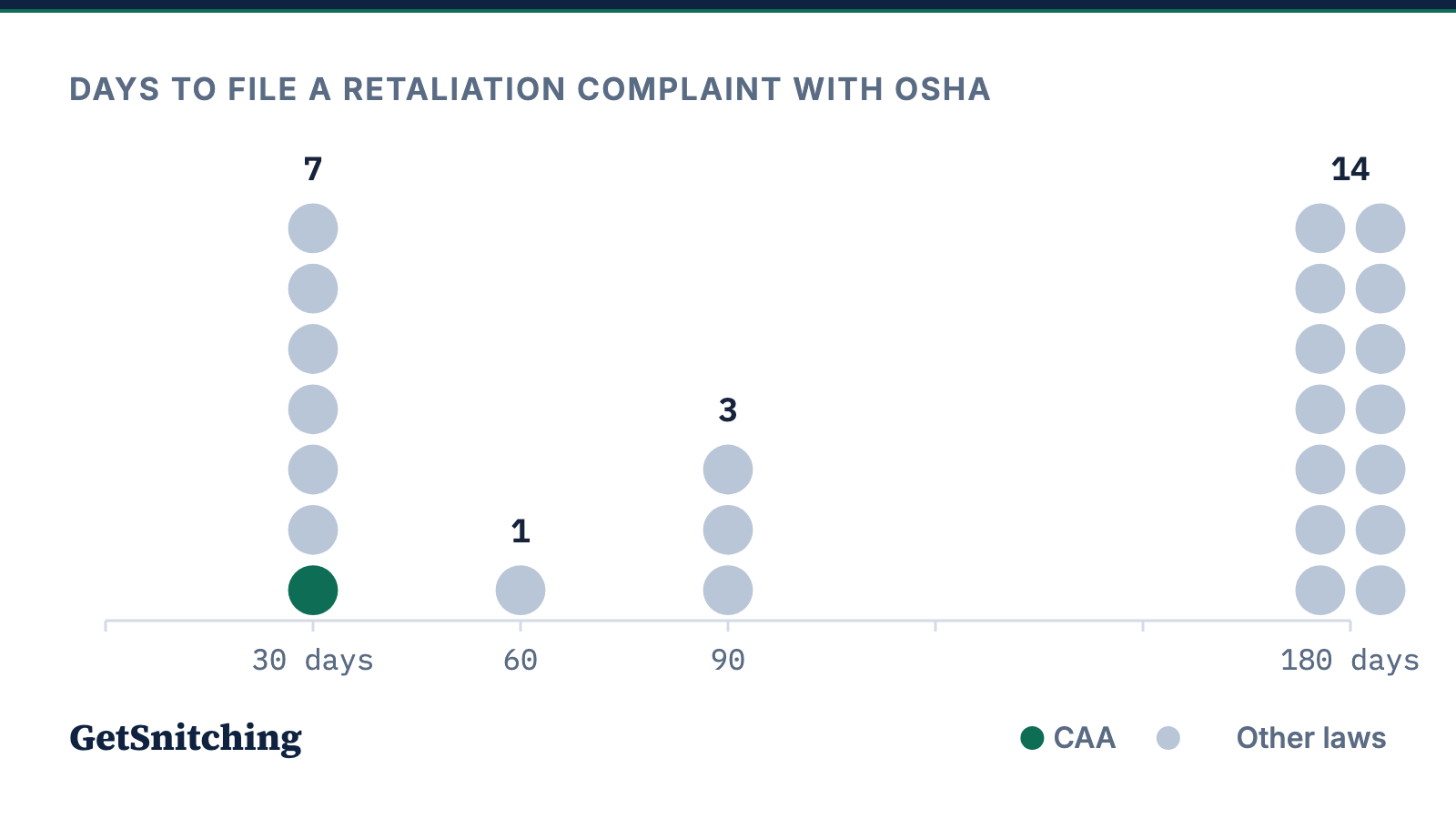
The Clean Air Act’s whistleblower provision protects employees who report air pollution violations: emissions from factories, power plants, and refineries, but also from mobile sources such as vehicles and engines. It is one of six environmental whistleblower laws OSHA enforces, and like the others it comes with a deadline so short that it ends more cases than weak facts do.
Thirty days, no grace period
You have 30 calendar days from the retaliatory act to file a complaint with OSHA. That is the shortest window in federal whistleblower law. If you were fired, demoted, or disciplined after reporting emissions problems, file first and gather documents second. A complaint can be made by phone, online, in writing, or in person, and it does not need to be on a special form.
Who is covered
The Clean Air Act applies to employers generally. Unlike some environmental laws, it also reaches government employers: OSHA’s desk aid explains that the Clean Air Act waives federal sovereign immunity, so a federal agency employee who reports an air-quality violation is protected too. State, local, and tribal government coverage has its own wrinkles that the desk aid works through.
What you have to show
Protected activity includes reporting potential violations relating to emissions from area, stationary, and mobile sources, whether you report to your employer, to EPA, or to a state air agency, and participating in proceedings under the Act. The Clean Air Act uses the “motivating factor” causation standard, which sits between the strict “but for” test of OSH Act Section 11(c) and the employee-friendly “contributing factor” test of newer laws.
Remedies and limits
If you win, you can be reinstated with back pay and compensatory damages, plus attorney’s fees and costs. Punitive damages are not available under the Clean Air Act, unlike the Safe Drinking Water Act and TSCA. OSHA cannot order preliminary reinstatement under the environmental statutes. You can request that OSHA issue findings on the record so far after 30 days, and either side has 30 days after OSHA’s findings to request a hearing before a Labor Department administrative law judge. There is no right to move the case to federal district court.
Is there a reward?
Section 7413(f) of the Clean Air Act lets EPA pay up to $10,000 to a person whose information leads to a criminal conviction or civil penalty. The award is discretionary, government employees are ineligible, and EPA runs no public program around it, so treat it as a possibility rather than a plan. Our EPA environmental whistleblower page explains the bounty provisions in full.
Emissions fraud can be bigger than the Clean Air Act
If a manufacturer rigged emissions testing, the same facts may involve false certifications to the federal government (qui tam), misled investors (SEC), or vehicle safety (NHTSA). Those programs pay rewards; the Clean Air Act essentially does not.
Other laws on the same 30-day clock
If your facts also touch one of these, the deadline is the same, but coverage and remedies differ.
- Comprehensive Environmental Response, Compensation, and Liability Act (CERCLA)
- Federal Water Pollution Control Act (Clean Water Act) (FWPCA)
- Section 11(c) of the Occupational Safety and Health Act (OSH Act 11(c))
- Safe Drinking Water Act (SDWA)
- Solid Waste Disposal Act (Resource Conservation and Recovery Act) (SWDA)
- Toxic Substances Control Act (TSCA)
Related reading
Compare all 25 OSHA whistleblower laws
Not legal advice
GetSnitching explains programs and processes in plain English from official sources. Whistleblower and reporting decisions can carry real legal risk. For advice about your situation, talk to a licensed attorney. Many whistleblower attorneys offer free consultations.
Official sources
- Whistleblower Statutes Summary Chart (OSHA, updated 5/13/2026)
- Clean Air Act | Whistleblower Protection Program
- Investigator's Desk Aid to the Whistleblower Protection Provisions of Six Environmental Statutes (OSHA)
- 42 U.S.C. 7413, Clean Air Act federal enforcement (awards for information at 7413(f))
Cite this page