WHIP explained: what the $25 million Fraud Whistleblower Incentive Program actually pays
Verified against official sources:
The headline numbers from the October 20, 2026 Oval Office announcement were $25 million, “up to $30,000,” and a “1% commission.” Only two of those three survive contact with the program’s written terms. Here is what the Fraud Whistleblower Incentive Program, or WHIP, actually is, what it pays, and what the announcement got ahead of.
Three names, one program
The White House calls it the Fraud Whistleblower Incentive Program. The Justice Department press release calls it the Whistleblower Rewards Program. The terms and conditions that govern your tip call it the National Fraud Enforcement Division Criminal Tip Rewards Pilot Program. They are the same thing: a pilot run by DOJ’s Fraud Division, the unit created in April 2026 under Assistant Attorney General Colin McDonald, and announced 19 days after his October 1 directive on fraud enforcement. The reporting portal is america.gov/fraud, which fraud.gov points to. Our program page has the full eligibility rules; this guide is about the numbers and the gap between the podium and the paperwork.
What the $25 million is
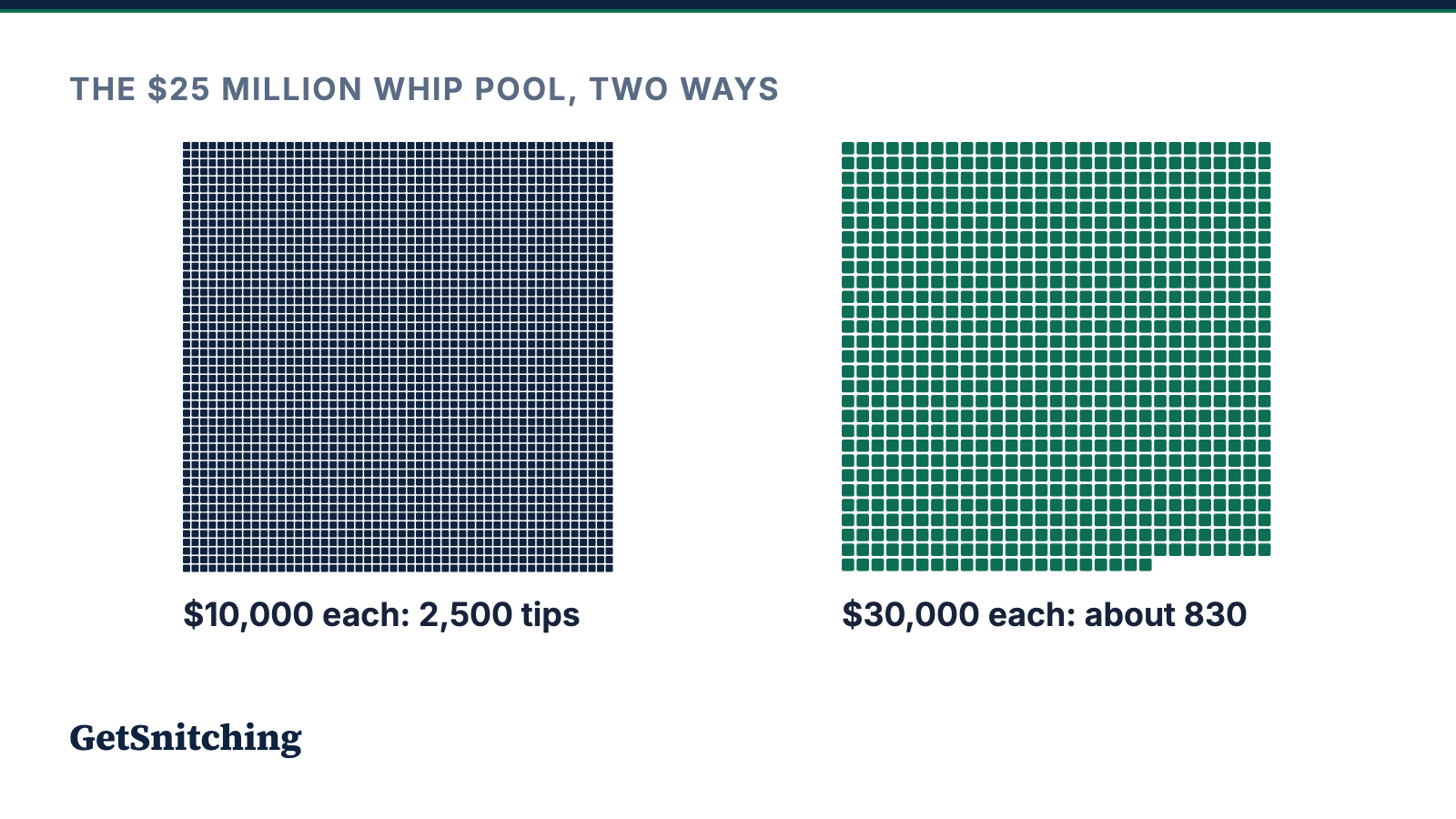
It is the pool, not the prize. The DOJ press release says the Treasury Department is committing $25 million to the program. At the written reward range of $10,000 to $30,000 per tip, that is enough to pay somewhere between roughly 830 and 2,500 tips, which tells you something about the scale DOJ is planning for: this is built for a high volume of ordinary tips about benefit-program fraud, not a handful of nine-figure corporate cases.
What “up to $30,000” means
The terms set a range of $10,000 to $30,000 for each distinct tip. The floor matters as much as the ceiling: a tip that qualifies at all is worth at least $10,000. DOJ decides, in its sole discretion, whether tips about related defendants are one tip or several, and whether to pay anything. If two people submit the same information, only the first is eligible. If two people bring separate original information about the same scheme, both can be paid.
The trigger is charges, not a conviction. The terms define criminal charges as an indictment, information, or criminal complaint that DOJ has obtained and unsealed, and say payment is made “at or around the time charges are filed.” Every other federal reward program waits for the government to collect money, which in SEC and False Claims Act cases means years. That is why DOJ’s own press release leads with speed and certainty rather than size.
What the “1% commission” is
Not in the terms. At the announcement the President said tipsters would receive 1% of the money recovered, with no cap, and that he would be “the arbitrator” of disputed claims. The DOJ terms, published the same day, say rewards are $10,000 to $30,000 at the Department’s sole discretion, that a Reward Determination is “neither appealable nor subject to judicial review,” and that the memorandum creates no enforceable rights. Nothing in the terms describes a percentage, a commission, or an arbitration process. The written terms are what the Fraud Division’s staff will apply when they review your submission, so plan around them. If DOJ later amends the terms to add a percentage, this page will say so with the date.
For context, a 1% share is far below what the existing percentage programs pay. The False Claims Act pays relators 15% to 30% of recoveries, the SEC and CFTC 10% to 30% of sanctions over $1 million, and the IRS 15% to 30% of collected proceeds. WHIP’s advantage is never going to be the percentage. It is that it pays on a tip, early, with no minimum loss amount and no need to hire a lawyer and file a lawsuit.
Who it is built for
The covered areas are health care fraud and fraud on programs run by Agriculture, Labor, HHS, HUD, Education, Veterans Affairs, War, and the SBA, with DOJ emphasizing hospice, home health, day care, and special services such as autism care. The first payment the White House announced, a $10,000 check to a video creator whose Minnesota day care footage preceded a July 2026 wire fraud plea, fits that profile exactly. The AP noted that the White House did not say whether that payment was tied to a tip that produced charges under the program’s terms.
Practically, the people best placed to collect are front-line workers and family members: a home health aide who sees visits billed that never happened, a parent whose child’s day care claims meals it never served, a billing clerk at a hospice, a landlord who sees a tenant’s HUD subsidy claimed twice, a student who was enrolled in a program that collected aid without teaching. None of those people would ever have filed a qui tam suit. All of them can fill out a form.
What it does not do
It does not protect you from being fired. The terms say DOJ “may” weigh retaliation against a company and “may” act on it; that is a prosecutor’s discretion, not a right you can sue on. See whistleblower retaliation protections explained for the statutes that do.
It does not let you stay anonymous on your own. Anonymous filing requires an attorney who verifies your identity and certifies the submission, and you must be identified before payment. The portal’s “your name is optional” applies to reporting, not to collecting.
It does not cover tax, securities, bank, or most contract fraud. Those go to the IRS, SEC, FinCEN, and qui tam programs, which still pay percentages.
It does not replace a qui tam case for a big fraud. A reward here does not bar a later award under another program on the same facts, so an insider with documents on a large scheme should read WHIP versus qui tam before choosing a path, because a well-timed hotline tip can complicate a later False Claims Act filing.
The dates that matter
The program’s terms and FAQ are dated October 20, 2026, and it runs for an initial three-year term. Tips go through the signed intake form at america.gov/fraud; the FAQ says DOJ may deny an award solely because a tip came in by another route. Our america.gov tip walkthrough covers the form itself, and the Fraud Tip Builder turns your answers into text for each field.
Not legal advice
GetSnitching explains programs and processes in plain English from official sources. Whistleblower and reporting decisions can carry real legal risk. For advice about your situation, talk to a licensed attorney. Many whistleblower attorneys offer free consultations.
Official sources
- Fraud Division Rewards Program, External Guidance Terms and Conditions (DOJ)
- Fraud Division Rewards Program, Frequently Asked Questions (DOJ)
- Justice Department Announces Innovative Whistleblower Rewards Program to Combat Fraud (DOJ press release 26-1231)
- Trump and Vance announce $25M whistleblower program to encourage public to report alleged fraud (AP via MPR News, October 20, 2026)
- Establishing the Task Force to Eliminate Fraud (White House presidential action, March 2026)