WHIP vs qui tam: $30,000 now or a share of the recovery later?
Verified against official sources:
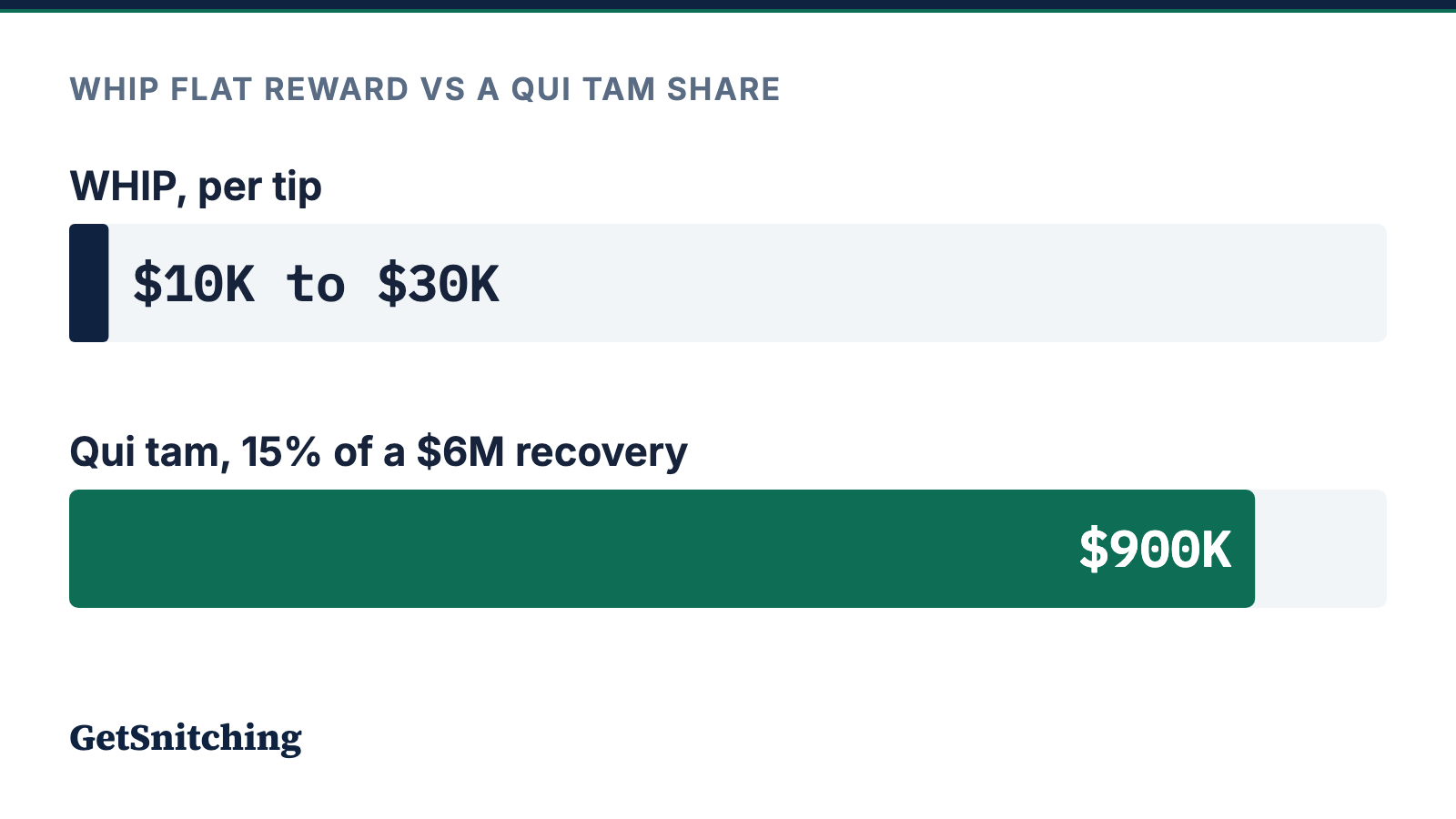
For the first time, someone who knows about health care or benefits fraud has two federal reward routes that overlap almost completely. The DOJ Fraud Rewards Program, announced October 20, 2026 as WHIP, pays a flat $10,000 to $30,000 when a tip leads to unsealed criminal charges. A qui tam case under the False Claims Act pays 15% to 30% of whatever the government recovers in a civil case. Both cover Medicare, Medicaid, SNAP, unemployment, HUD, student aid, VA, and SBA fraud. They differ on almost everything else.
The side-by-side
Amount. WHIP: $10,000 to $30,000 per distinct tip, no percentage, no minimum loss. Qui tam: 15% to 25% of the recovery if the government joins the case, 25% to 30% if it declines and your lawyer litigates alone, capped at 10% when the case rests mainly on public disclosures. Treble damages plus per-claim penalties make the base large: on a $2 million overbilling, the government can recover $6 million plus penalties, and a 15% relator share of that is $900,000.
When you are paid. WHIP: at or around the time charges are unsealed. Qui tam: after the government collects, which for an intervened case typically means years of sealed investigation, then settlement or trial, then payment.
What has to happen. WHIP needs a criminal case: an indictment, information, or complaint. Qui tam is civil; the defendant never has to be charged with a crime. Most False Claims Act recoveries come from settlements with companies that are never prosecuted.
Who can file. WHIP: any individual who is not excluded, with no lawyer required. Qui tam: a lawsuit filed under seal in federal court, which in practice requires a lawyer, and an individual cannot represent the United States without one.
Anonymity. WHIP: anonymous only through an attorney, and you must be identified before payment. Qui tam: the complaint is sealed for at least 60 days and often much longer, but your name is on it from day one and the defendant learns it when the seal lifts.
Certainty. WHIP rewards are in DOJ’s sole discretion and not appealable. A qui tam relator share is a statutory entitlement once the case recovers money; the only discretion is where in the range it lands.
Retaliation. WHIP creates no protection of its own. The False Claims Act’s anti-retaliation section, 31 U.S.C. 3730(h), gives you reinstatement, double back pay, and fees if you are punished for lawful acts in furtherance of an FCA claim.
Who should take the $30,000
Take WHIP when the fraud is small, criminal, and specific. A day care claiming meals for children who were never there, a home health agency billing visits that did not happen, a person collecting unemployment on a stolen identity, a hospice enrolling patients who are not dying. These are the cases DOJ says it is emphasizing, and they are exactly the cases where a civil qui tam suit makes no economic sense: the dollar amounts are too small to interest a contingency-fee lawyer, and a criminal charge is the realistic outcome anyway.
Take WHIP when you are not an insider. Qui tam rewards original-source insiders with documents. WHIP’s originality test is the same in spirit, but a flat reward on a tip is reachable for a neighbor, a patient, a parent, or a former employee without a file cabinet.
Take WHIP when you need the money inside a year or two, not in five.
Who should file qui tam instead
File qui tam when the fraud is large and systematic and you have the documents to prove it. Fiscal 2025 False Claims Act recoveries topped $6.8 billion, and the relator share on a single major health care settlement routinely runs into seven figures. No WHIP award will ever exceed $30,000 per tip.
File qui tam when the wrongdoer is a company that will settle rather than a person who will be charged. Corporate health care fraud mostly ends in civil settlements; a WHIP tip about it may never produce the unsealed criminal charge that triggers payment.
File qui tam when you need retaliation protection with teeth. Section 3730(h) is the strongest general whistleblower remedy in federal law for fraud on government money.
Why the order matters
The two routes are not exclusive. The WHIP terms say a reward there does not bar a later payment under another program on the same facts. But the mechanics cut the other way too, and they are where people get hurt.
First, the False Claims Act’s public disclosure bar. If your tip leads to an unsealed criminal charge, the allegations become public, and a qui tam suit filed afterward can be dismissed as based on public disclosures unless you qualify as an original source. The bar has an original-source exception, but you want to be sure you fit it before you let the criminal case go public ahead of your civil filing.
Second, the first-to-file rule. Under 31 U.S.C. 3730(b)(5), once one relator files a qui tam case on a set of facts, nobody else can bring a related action on them. A WHIP tip does not start that clock, but a competing relator’s filing does, and a public indictment is an invitation for someone else’s lawyer to file on the same facts.
Third, voluntariness. WHIP’s terms say a tip is not voluntary if you were under a prior obligation to report or facing a government request. Filing qui tam first does not create that kind of obligation, but cooperating with a criminal investigation after a tip can shape what you are free to do in a civil case.
The practical sequence for an insider with a large case: talk to a False Claims Act lawyer before submitting anything to the portal. A lawyer can file the qui tam complaint under seal, which preserves your original-source status and first-to-file position, and then submit the WHIP tip through the portal with the attorney’s certification, which also gets you the only route to anonymity the program offers. For a small, criminal, specific fraud with no lawyer in the picture, skip all of that and file the tip. Our guide on whether you need a whistleblower lawyer covers how contingency representation works and what it costs you.
The honest comparison
WHIP is the better deal for the many. Qui tam is the better deal for the few. The money in whistleblowing has always been concentrated in a small number of large, document-backed insider cases, and nothing about WHIP changes that. What WHIP changes is that the other 99% of fraud tips, the ones that were never going to become lawsuits, now have a price tag of at least $10,000 if they lead to charges. For most people reading this, that is the only offer on the table, and it is a real one.
Not legal advice
GetSnitching explains programs and processes in plain English from official sources. Whistleblower and reporting decisions can carry real legal risk. For advice about your situation, talk to a licensed attorney. Many whistleblower attorneys offer free consultations.
Official sources
- Fraud Division Rewards Program, External Guidance Terms and Conditions (DOJ)
- Fraud Division Rewards Program, Frequently Asked Questions (DOJ)
- 31 U.S.C. 3730, False Claims Act civil actions
- False Claims Act Settlements and Judgments Exceed $6.8B in Fiscal Year 2025 (DOJ)
- The False Claims Act (DOJ Civil Division, Fraud Section)