DOJ Fraud Rewards Program (WHIP): $10,000 to $30,000 for tips that lead to criminal charges
Verified against official sources:
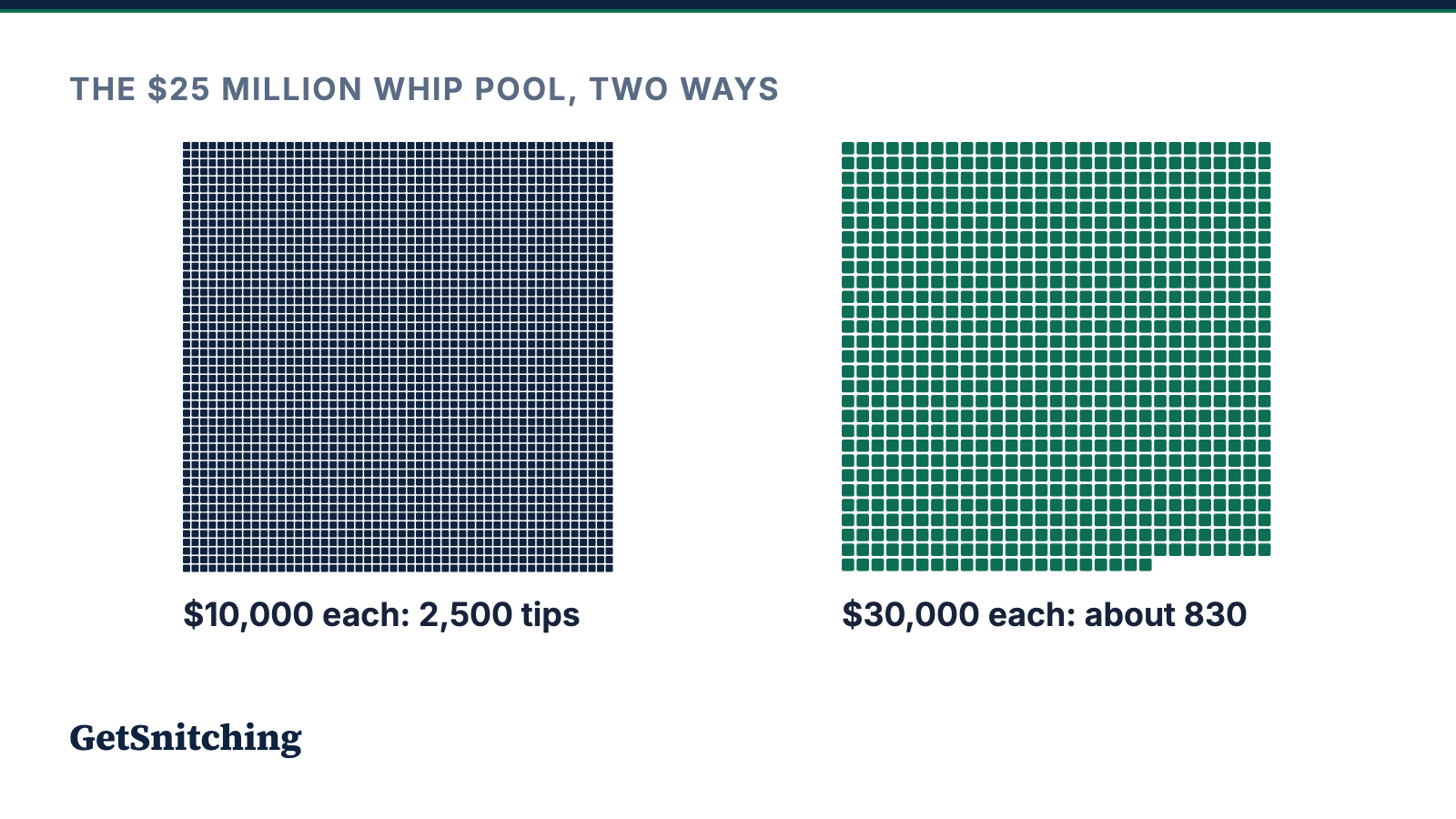
On October 20, 2026, the Justice Department opened the first federal whistleblower reward program that pays before a case is over. The National Fraud Enforcement Division’s Criminal Tip Rewards Pilot Program, which the White House announced the same day as the Fraud Whistleblower Incentive Program, or WHIP, pays $10,000 to $30,000 for an original tip that leads to unsealed federal criminal charges in a covered fraud area. The payment comes at or around the time charges are filed, not after a conviction, forfeiture, or appeal. That timing is the whole point of the program, and it is the single biggest difference between this and every other reward program on this site.
This page is built from the DOJ’s own terms and conditions and FAQ, both dated October 20, 2026, and from the DOJ press release. Where the Oval Office remarks that announced the program differ from the written terms, we say so, because the written terms are what the Fraud Division will apply to your tip.
Who qualifies
You must be an individual. Companies and other entities cannot collect. Beyond that, the terms set six requirements that run through the whole program:
- Voluntary. You came forward on your own. A tip is not voluntary if DOJ or federal law enforcement already asked you about the subject, if you were under a subpoena or a cooperation obligation, or if you had a pre-existing duty to report it.
- Truthful and complete. False statements or withheld material facts do not just cost you the reward. The terms warn that they can be prosecuted as false statements or perjury, and that three or more frivolous or fraudulent submissions can get you barred from the program for good.
- Original. Based on your own independent knowledge or your own analysis, not already known to DOJ, and not simply repeating a news story, a court filing, or another public allegation unless you were the source of it.
- In writing. Through the signed intake form at america.gov/fraud.
- Cooperative. You agree to help the investigation, including producing documents and testifying if asked.
- Productive. The information has to lead to criminal charges in a covered subject area. “Charges” means an indictment, information, or criminal complaint that DOJ has obtained and unsealed.
The covered subject areas are narrower than the word “fraud” suggests. The program takes tips about federal health care offenses, including fraud against patients or others in the health care industry, and about fraud on programs and benefits run by the Departments of Agriculture (SNAP, for example), Labor (unemployment insurance), Health and Human Services, Housing and Urban Development, Education (student aid), Veterans Affairs, and War, and by the Small Business Administration. DOJ says it is giving particular emphasis to hospice, home health care, day care, and special services fraud, including autism care, and that it may expand the list later. Fraud on a state, local, or tribal program still counts if a federal program ultimately bears the loss. There is no minimum loss amount; the FAQ says a scheme that failed or lost little money can still qualify if it leads to charges.
Several people are excluded no matter how good their information is: current or former DOJ and law enforcement officials, employees, and contractors, and their close family and household members; elected or appointed foreign government officials; and anyone who meaningfully participated in the fraud by directing, planning, initiating, or knowingly profiting from it. A person with a minimal role may still qualify at DOJ’s discretion, with that role counting against the amount. Information from attorney-client privileged communications is out, as is information you learned in a compliance, audit, or internal-investigation role, subject to narrow exceptions for imminent harm or an investigation being impeded. Information you obtained illegally is out, and submitting it gives you no protection from prosecution.
What it pays
The amount is a flat range, not a share: $10,000 to $30,000 for each distinct tip, with DOJ deciding whether two tips are distinct or related. More than one person can be paid on the same matter if each brought separate original information, but if two people submit the same information only the first to file is eligible. The DOJ press release says Treasury is committing $25 million to the program, which is where the “$25 million” in the headlines comes from; it is the pool, not a cap on any one person.
Payment timing is the program’s selling point. The terms say rewards are paid “at or around the time charges are filed.” Nothing is payable while charges stay sealed unless DOJ decides otherwise, and once an indictment or complaint is unsealed the Fraud Division contacts eligible tipsters soon afterward. Payment does not wait for a guilty plea, sentencing, or appeals. A reward here also does not bar you from collecting under another program on the same facts later; the terms name the Criminal Division’s Corporate Whistleblower Awards Pilot Program as an example.
Two things the announcement said are not in the written terms. The President described payments as a 1% commission on the fraud uncovered with no ceiling, and said he would personally arbitrate disputed claims. The DOJ terms say the opposite on both points: the amount is $10,000 to $30,000, rewards are in the Department’s “sole discretion,” and a Reward Determination is “neither appealable nor subject to judicial review.” The terms also say the program creates no enforceable rights for anyone. Until the terms change, plan around the written numbers.
How to file, step by step
1. Check that your fraud is in a covered area. Health care, or one of the eight listed agencies’ programs. If it is tax fraud, securities fraud, or a government contract outside those agencies, a different program on this site fits better; see the comparison in WHIP versus qui tam.
2. Write down the specifics. DOJ’s FAQ asks tipsters to identify the specific violation, the subjects, and the source of your information. Names, dates, amounts, how the money moved, and where the records are. Our america.gov tip walkthrough covers what the form asks for, and the free Fraud Tip Builder checks your eligibility and writes the text for each field.
3. Submit the signed intake form at america.gov/fraud. The Department “strongly prefers” the portal and the FAQ says it may deny an award solely because a tip arrived some other way. If you have already reported the same facts to an agency hotline, file again through the portal; the terms do not say that an earlier hotline report counts.
4. Decide on anonymity before you file. You can file anonymously only through an attorney, who must verify your identity and certify that the information is true, correct, and complete. You will have to disclose and verify your identity before any payment. A lawyer is not otherwise required.
5. Keep your evidence and stay reachable. Portal submissions are reviewed by Fraud Division staff. You may or may not be contacted for more, and cooperation is a condition of the reward.
Timeline reality
This is a pilot with an initial three-year term, announced October 20, 2026, and it has paid nothing under its own terms yet. The event that triggers payment, unsealed charges, can come months or years after a tip depending on how long the investigation takes and whether prosecutors can bring charges within the statute of limitations, which is why the FAQ stresses timeliness. The structural advantage is real, though. Under the False Claims Act, SEC, and IRS programs, money arrives only after the government has collected, and those clocks routinely run three to five years. Here the clock stops at charges.
Retaliation protection
Read this part carefully, because the program creates none of its own. The terms say tipsters should report retaliation, that DOJ “may” consider it when assessing a company’s cooperation or obstruction, and that DOJ “may” take enforcement action. That is a prosecutorial lever, not a right you can enforce. Whether you have an actual legal remedy depends on whether some other statute covers your situation: the False Claims Act’s anti-retaliation section if the fraud involved federal money and you took steps toward an FCA claim, a state law, or one of the sector statutes on our whistleblower protections pages. The terms do add that an employer’s effort to block you from talking to DOJ, including by enforcing a confidentiality agreement, can count against the company, and that DOJ may contact an employee who reaches out directly without going through the employer’s lawyers.
Common mistakes
Reporting a fraud outside the covered list and expecting a reward. Bank fraud, securities fraud, tax evasion, and most procurement fraud are not covered unless they also involve one of the listed programs. The FAQ encourages reporting anyway, but no reward attaches.
Assuming the hotline you already called counts. The portal is the preferred channel and DOJ can deny a reward for a tip that came in another way.
Submitting what is already public. A tip assembled from news reports or court records fails the originality test unless you were the original source.
Filing anonymously without a lawyer. The portal accepts reports without a name, but under the reward terms anonymity requires an attorney’s certification, and you must be identified before any check is cut.
Counting on the 1% commission. It is not in the terms. The written range is $10,000 to $30,000.
Treating the reward as retaliation insurance. It is not. If your job is at risk, read whistleblower retaliation protections explained before you file.
If the fraud involves large dollars and you are an insider with documents, you may be leaving money on the table by stopping here: a qui tam case under the False Claims Act pays 15% to 30% of what the government recovers, and the two are not mutually exclusive. How much do whistleblowers actually get paid puts the numbers side by side.
Not legal advice
GetSnitching explains programs and processes in plain English from official sources. Whistleblower and reporting decisions can carry real legal risk. For advice about your situation, talk to a licensed attorney. Many whistleblower attorneys offer free consultations.
Official sources
- Whistleblower Rewards Program (DOJ National Fraud Enforcement Division)
- Fraud Division Rewards Program, External Guidance Terms and Conditions (DOJ)
- Fraud Division Rewards Program, Frequently Asked Questions (DOJ)
- Justice Department Announces Innovative Whistleblower Rewards Program to Combat Fraud (DOJ press release 26-1231, October 20, 2026)
- Report fraud, waste, or abuse (America.gov, Task Force to Eliminate Fraud)
- 28 U.S.C. 530C, Authority to use available funds
Cite this page