How to report hospice fraud: who to call and whether it pays
Verified against official sources:
Report hospice billing fraud to the HHS Office of Inspector General at 1-800-HHS-TIPS (1-800-447-8477) or through its online form, and report fraud on a state Medicaid hospice benefit to that state’s Medicaid Fraud Control Unit. If you want to be eligible for a reward, also file through the Justice Department’s portal at america.gov/fraud: its new rewards program pays $10,000 to $30,000 when a tip leads to criminal charges, and hospice is one of four areas DOJ says it is emphasizing. Neglect or poor care goes to your state health department, and anyone in danger needs 911. The free Fraud Tip Builder writes the america.gov tip for you, in your browser.
Warning signs of hospice fraud
Medicare covers hospice when the hospice doctor and the patient’s regular doctor certify a terminal illness with a life expectancy of six months or less, and the patient accepts comfort care instead of treatment to cure the illness. After the first two 90-day periods, each 60-day recertification requires a face-to-face visit with a hospice doctor or nurse practitioner. Most hospice fraud is a lie about one of those facts, or a payment to get the patient in the door. Signs to watch for:
- The patient did not know they were in hospice. HHS-OIG has documented recruiters signing up people who were not eligible and did not even know they had been enrolled. Electing hospice ends Medicare coverage of curative treatment for the illness; OIG describes a woman removed from a liver transplant list after a hospice falsely told her she could stay on it.
- Stable patients recertified for years. One Florida hospice settled allegations about 63 patients whose stays exceeded three years; another settled allegations about patients billed for four or more years who were not terminally ill for at least part of that time. A long stay is not fraud by itself; charts that never describe decline, recertified period after period, are the red flag.
- Admission targets that override the chart. Census quotas, or managers overruling nurses who say a patient is not eligible.
- A higher level of care than the patient needs. Medicare pays four daily rates: routine home care, continuous home care, inpatient respite care, and general inpatient care. Continuous home care is for short medical crises and, according to a 2015 DOJ release, pays nearly six times the routine daily rate. Crisis care billed when there was no crisis is a known scheme, and OIG describes a hospice that billed 17 days of general inpatient care for a 70-year-old it never visited, phoning his family instead.
- Pay tied to referrals. Medical director stipends that rise when a doctor refers more patients, cash or gift cards to doctors, nurses, or facilities, and recruiters paid per patient.
- Favors to nursing homes. OIG’s fraud alert on hospice and nursing home arrangements names free goods to a nursing home, or room and board payments above what Medicaid would have paid, as suspected kickbacks to win referrals of residents.
- Live discharges at odd moments. CMS tells state surveyors that an unusually high rate of patients discharged alive can mean a hospice is admitting patients who do not meet eligibility, and to look for discharges on a weekend or holiday or tied to an ER visit or hospitalization. The mirror image also appears in OIG’s files: a chain that allegedly discouraged its doctors from discharging ineligible patients.
Where to report, and which channel to use
Medicare billing fraud: HHS-OIG. Call 1-800-HHS-TIPS (1-800-447-8477), TTY 1-800-377-4950, or use the online form at oig.hhs.gov/fraud/report-fraud (tips.hhs.gov redirects there). OIG asks for the business’s details, what happened, when, and how you learned it, anyone who can corroborate it, and documents. It cannot contact every complainant and will not confirm receipt. You can file anonymously, but OIG warns that anonymity prevents it from treating your complaint as a whistleblower retaliation complaint. 1-800-MEDICARE (1-800-633-4227) also takes fraud reports.
Medicaid hospice fraud: the state Medicaid Fraud Control Unit. The 53 units, usually in the attorney general’s office, prosecute Medicaid provider fraud and abuse or neglect of residents in health care facilities. This matters for nursing home residents: OIG’s fraud alert explains that when a hospice patient in a nursing home is also on Medicaid, Medicaid pays the hospice, which then pays the nursing home for room and board. Our state Medicaid fraud pages name each unit.
For a reward: america.gov/fraud. Choose “Report benefits fraud” and complete the signed intake form. DOJ’s FAQ says it may deny an award solely because a tip did not come through the portal, and that original information cannot already be known to the Fraud Division or law enforcement. If a reward matters, file there first or alongside any hotline call.
Poor care, neglect, or abuse: the state health department. OIG’s hospice rights sheet tells families to report abuse, neglect, or poor care to the hospice administrator, the state department of health, 1-800-MEDICARE, and the police if a crime was committed. CMS’s State Survey Agency directory lists each state’s number, and some states list a separate hospice line. A patient can switch hospices once per election period.
If the hospice says it is ending care: the patient should receive a Notice of Medicare Non-Coverage at least two days before services end and can ask the independent BFCC-QIO reviewer for a fast appeal by noon the day before the end date.
Immediate danger: 911. For abuse or neglect of a patient living at home, Adult Protective Services takes reports in every state; the Eldercare Locator, 1-800-677-1116, finds local aging services.
In California: Medi-Cal hospice fraud goes to the Attorney General’s Division of Medi-Cal Fraud and Elder Abuse (DMFEA) online. The Department of Public Health investigates care complaints but says it has no role in monitoring claims, so billing fraud belongs with DMFEA or HHS-OIG.
Does reporting hospice fraud pay?
A hotline call alone does not. Two programs can.
The DOJ Fraud Rewards Program, announced as WHIP, pays $10,000 to $30,000 per distinct tip, at or around the time criminal charges are filed and unsealed, at DOJ’s discretion. Its terms place “particular emphasis” on hospice, home health care, day care, and special services fraud. There is no minimum loss, and no lawyer is needed unless you file anonymously. Anyone who meaningfully participated is ineligible.
A False Claims Act qui tam case is the route for an insider with documents. A lawyer files it under seal, and the whistleblower receives 15% to 25% of the recovery if the government takes over the case, or 25% to 30% if it does not. A WHIP reward does not bar a later award under another program. WHIP vs. qui tam compares the two.
What the settlement record shows
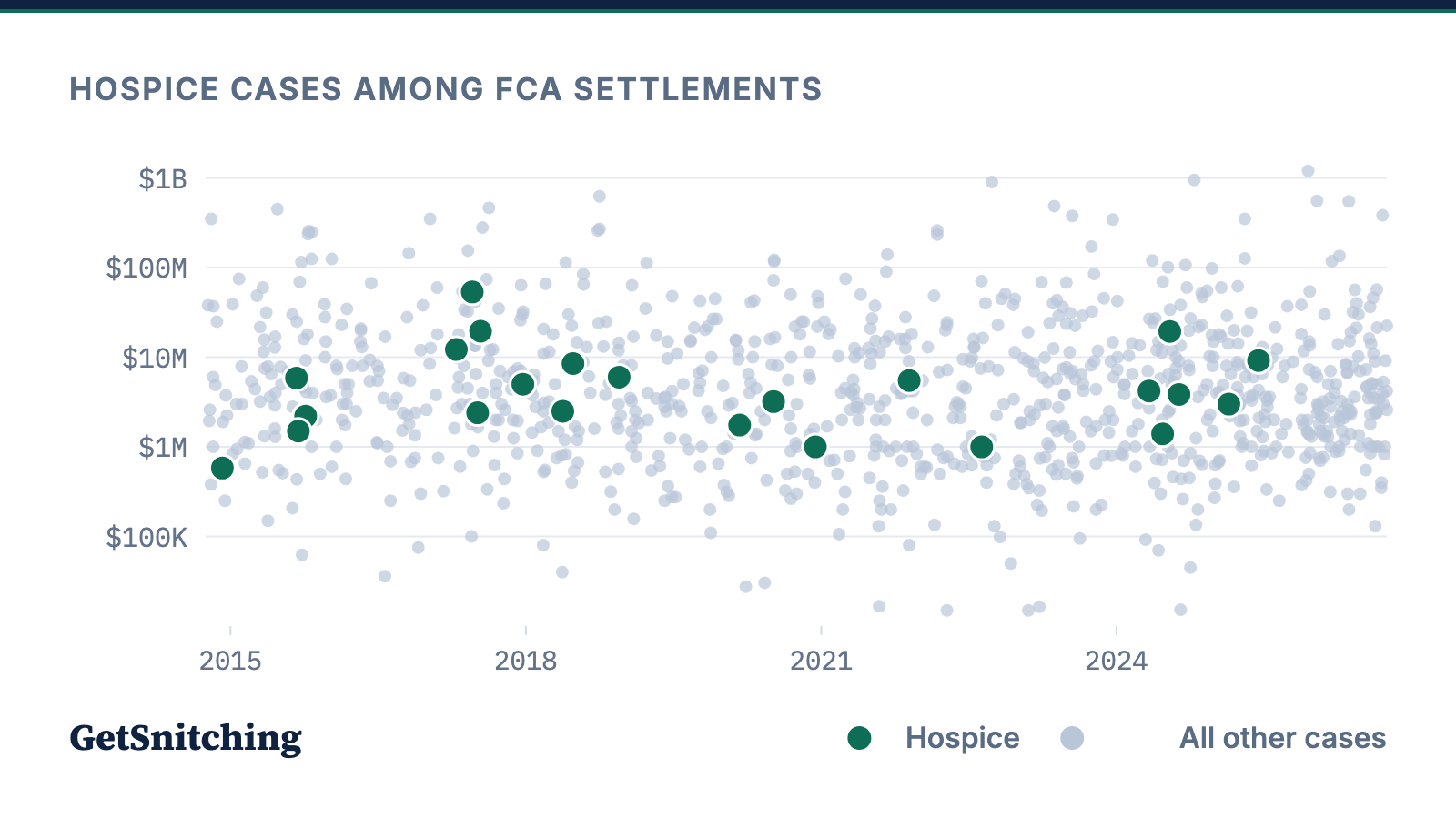
We read every hospice False Claims Act settlement in our corpus of DOJ press releases dated October 1, 2014 (the start of FY2015) through October 31, 2026. Twenty-three were brought by whistleblowers and resolved, totaling about $173 million, with a median of $3.85 million and a range of $581,000 to $53.6 million. Four of them, together about $78 million, also settled therapy, nursing home, or home health claims, so not every dollar was hospice billing; the other 19 total about $95 million. These are the matters DOJ chose to announce in press releases, a sample rather than every case.
Fifteen of the 23 alleged billing for ineligible patients, six alleged kickbacks for referrals, and three alleged an unneeded higher level of care. At least 17 releases describe the whistleblower as a current or former employee, among them nurses, a director of hospice care, and a marketer. In the nine releases that state the whistleblowers’ share, it worked out to 16% to 19% of the settlement. Five examples:
- Caris Healthcare, $8.5 million (2018): the government alleged Caris admitted patients to meet “aggressive admissions and census targets” and kept billing after internal audits, its chief medical officer, and its own nurses flagged them. A registered nurse brought the case; her share was $1,402,500.
- St. Joseph Hospice, about $5.87 million (2015): continuous home care billed when there was no crisis. Three former employees shared a little more than $1 million.
- Alive Hospice, over $1.5 million (2015): general inpatient care billed for patients who did not qualify for it. A triage nurse brought the case and received $263,197.
- Hospice Plus and affiliates, $12.21 million (2017): alleged kickbacks, from sham loans to gift cards, to a physician house-call company and to doctors, nurses, hospitals, and long-term care facilities.
- Creative Hospice, $9.2 million (2025): medical director pay that allegedly rose with referrals and fell without them. A former marketing employee filed first.
Settlements resolve allegations only, without a finding of liability. Search the full set in our False Claims Act settlements database.
If you work for the hospice
The False Claims Act protects any employee, contractor, or agent who is fired, demoted, threatened, or harassed for lawful steps to stop a violation or to pursue a False Claims Act case. Relief includes reinstatement, two times back pay with interest, special damages, and attorney fees, and the lawsuit must be filed within three years of the retaliation (31 U.S.C. 3730(h)). The DOJ rewards program creates no job protection of its own. See False Claims Act retaliation and how to report fraud anonymously.
What to write down
Keep a dated record on a personal device:
- each patient involved (name or initials), admission date, hospice diagnosis, recertification dates, and who signed the terminal illness certification;
- the level of care billed against what happened: dates of crisis care or inpatient days, and whether anyone was actually at the bedside;
- visits scheduled against visits made;
- census targets, admissions bonuses, or instructions to admit or keep patients, with who said it and when;
- payments or gifts to doctors, recruiters, or facilities;
- for families, the patient’s Medicare Summary Notice and the hospice election statement they signed.
Do not take records you are not authorized to remove; describe where they are. The reward terms exclude illegally obtained information. The Fraud Tip Builder has a hospice checklist and writes the tip for you. If the patient is on home health rather than hospice, see how to report home health fraud.
Not legal advice
GetSnitching explains programs and processes in plain English from official sources. Whistleblower and reporting decisions can carry real legal risk. For advice about your situation, talk to a licensed attorney. Many whistleblower attorneys offer free consultations.
Official sources
- Report Fraud, Waste, and Abuse (HHS Office of Inspector General)
- Other Ways to Contact the Hotline (HHS-OIG)
- Disclosing Your Identity (HHS-OIG Hotline)
- Medicaid Fraud Control Units (HHS-OIG)
- Hospice care coverage (Medicare.gov)
- Reporting Medicare fraud and abuse (Medicare.gov)
- Getting a fast appeal from non-hospital settings (Medicare.gov)
- State Survey Agency contact information (CMS)
- State Operations Manual, Appendix M, Guidance to Surveyors: Hospice (CMS, Rev. 222)
- Vulnerabilities in the Medicare Hospice Program Affect Quality Care and Program Integrity, OEI-02-16-00570 (HHS-OIG, July 2018)
- Special Fraud Alert: Fraud and Abuse in Nursing Home Arrangements With Hospices (HHS-OIG, March 1998)
- Medicare Hospice Patients: Know Your Rights, Take Action (HHS-OIG)
- Fraud Division Rewards Program, External Guidance Terms and Conditions (DOJ)
- Fraud Division Rewards Program, Frequently Asked Questions (DOJ)
- Report fraud, waste, or abuse (America.gov)
- 31 U.S.C. 3730, Civil actions for false claims (Cornell LII)
- Report Medi-Cal fraud or elder abuse (California Attorney General, DMFEA)
- Hospice and Home Health Agency Program Integrity Fact Sheet (California Department of Public Health)
- Contact Us: abuse, neglect, and exploitation (Administration for Community Living)
- Adult Protective Services, What You Must Know (ACL fact sheet)
- Caris Agrees to Pay $8.5 Million (DOJ, June 25, 2018)
- St. Joseph Hospice entities to pay approximately $5.86 million (DOJ, S.D. Miss., September 3, 2015)
- Alive Hospice pays over $1.5 million (DOJ, M.D. Tenn., September 10, 2015)
- Hospice Companies To Pay $12.2 Million To Settle Kickback Claims (DOJ, N.D. Tex., April 18, 2017)
- Creative Hospice settles kickback claims for $9.2 million (DOJ, N.D. Ga., June 11, 2025)
- Haven Hospice settles for more than $5 million (DOJ, M.D. Fla., December 21, 2017)
- Hope Hospice agrees to pay $3.2 million (DOJ, M.D. Fla., July 8, 2020)
- DOJ press releases API (corpus of False Claims Act settlement releases, FY2015 to October 31, 2026)