How to report home health care fraud: who to call
Verified against official sources:
Report Medicare home health fraud to the HHS Office of Inspector General at 1-800-HHS-TIPS (1-800-447-8477) or online, and report Medicaid home care fraud, including aides and personal care agencies billing for hours they did not work, to your state’s Medicaid Fraud Control Unit. To be eligible for a reward, also file at america.gov/fraud: DOJ’s new rewards program pays $10,000 to $30,000 when a tip leads to criminal charges and names home health care as a priority. Neglect or abuse of someone at home goes to Adult Protective Services, and danger goes to 911. The free Fraud Tip Builder writes the america.gov tip for you, in your browser, without sending us anything.
Two programs pay for care at home, and they decide where your report goes. Medicare home health is skilled nursing or therapy, ordered by a doctor, for a patient who is homebound; an aide is covered only alongside that skilled care. Medicaid personal care pays aides for help with bathing, dressing, and meals, often through an agency. Medicare does not pay for personal care when it is the only care someone needs.
Warning signs of home health fraud
- Homebound on paper only. Medicare treats a patient as homebound when leaving home is not recommended or takes help (a cane, a wheelchair, special transportation, another person), and the patient is normally unable to leave and doing so takes a lot of effort. Trips for medical care and short, infrequent outings are allowed. A patient who drives, works, or runs errands every day is unlikely to qualify, and HHS-OIG has described physicians falsely certifying exactly that.
- A doctor the patient never saw. Medicare requires a doctor or other provider to see the patient in person and confirm the need for home health. OIG says the physicians in these schemes typically were not the patients’ primary care doctors, who often did not know their patients were getting home health at all.
- Visits that did not happen. Billing for days the patient was in the hospital is a recurring pattern: one Philadelphia agency allegedly submitted 1,141 Medicaid claims for in-home personal care on days when the 209 patients involved were hospital inpatients all day. Ask the patient or family whether the nurse or aide actually came.
- Timesheet and visit-log games. Federal law requires states to verify Medicaid personal care and home health visits electronically, recording the type of service, who received it, the date, the location, who provided it, and when it started and ended. That system, known as electronic visit verification (EVV), is only as honest as the people using it. In settlements in our data, companies allegedly told caregivers to charge more time than they spent, billed when staff were not physically present, and directed employees to get around the agency’s own checks that aides were in the home. Visit records entered or edited after the fact deserve a note in your log.
- Unqualified staff billed as qualified. Untrained workers billed as home health aides, or care supervised by a nurse whose license had lapsed.
- Extra visits for a better payment. Clinicians pressured to add visits so the agency avoids a lower Medicare payment, or patients’ conditions recorded as more severe than they are.
- Paying for patients. Medical director fees for doctors who refer, spouses of referring doctors on the payroll, marketers paid to bring in patients, and cash or gifts to patients and families. One agency allegedly made cash payments of up to $5,000 for patient referrals through a “friends and family” program.
A caution for aides: if you were pressured into signing false timesheets, say so plainly. The rewards program excludes anyone who meaningfully participated, but DOJ can still consider someone with a minimal role, and a lawyer can assess your position before you file (see WHIP vs. qui tam).
Where to report, and which channel to use
Medicare home health billing: HHS-OIG. Call 1-800-HHS-TIPS (1-800-447-8477), TTY 1-800-377-4950, or use the online form at oig.hhs.gov/fraud/report-fraud (tips.hhs.gov redirects there). OIG asks for the agency’s details, what happened, when, how you know, who can back it up, and any documents. An anonymous report is accepted, but OIG says it then cannot treat your complaint as a retaliation complaint. Medicare.gov also takes fraud reports at 1-800-MEDICARE (1-800-633-4227).
Medicaid home care and personal care: the state Medicaid Fraud Control Unit. Personal care is the units’ biggest fraud category: in fiscal year 2025 the 53 units recorded 856 fraud convictions, and 326 of them involved personal care attendants, more than five times the next provider type (63). The units also handle abuse or neglect of Medicaid enrollees in settings other than facilities. Find yours on our state Medicaid fraud pages.
For a reward: america.gov/fraud. Choose “Report benefits fraud,” which covers Medicare, Medicaid, and other federal programs, and complete the signed intake form. DOJ’s FAQ says it may deny an award solely because a tip came in another way, and that original information cannot already be known to the Fraud Division or law enforcement, so file there first or alongside any hotline call. Two settlements in our data involved in-home care billed to the Labor Department’s program for sick energy workers; Labor programs are covered by the rewards program too.
Poor care: the agency, then the state. Medicare.gov says to ask for the agency’s administrator first, then call your state’s home health hotline, a number the agency should give you when care starts. CMS lists every State Survey Agency, which investigates care complaints.
Abuse, neglect, or exploitation at home: Adult Protective Services. APS responds to reports in private homes in every state. Call 911 if someone is in immediate danger.
If the agency says Medicare care is ending: the patient should get a Notice of Medicare Non-Coverage at least two days ahead and can request a fast appeal from the BFCC-QIO by noon the day before services stop.
Does reporting home health fraud pay?
Not through a hotline call alone. The DOJ Fraud Rewards Program pays $10,000 to $30,000 per distinct tip at or around the time criminal charges are filed and unsealed, and its terms name home health care among four areas of “particular emphasis.” There is no minimum loss, and no lawyer is needed unless you file anonymously.
A False Claims Act qui tam case fits an insider with documents. A lawyer files under seal; the whistleblower receives 15% to 25% of the recovery if the government takes over, or 25% to 30% if it does not. A rewards-program payment does not bar a later award under another program, so the two can be combined.
What the settlement record shows
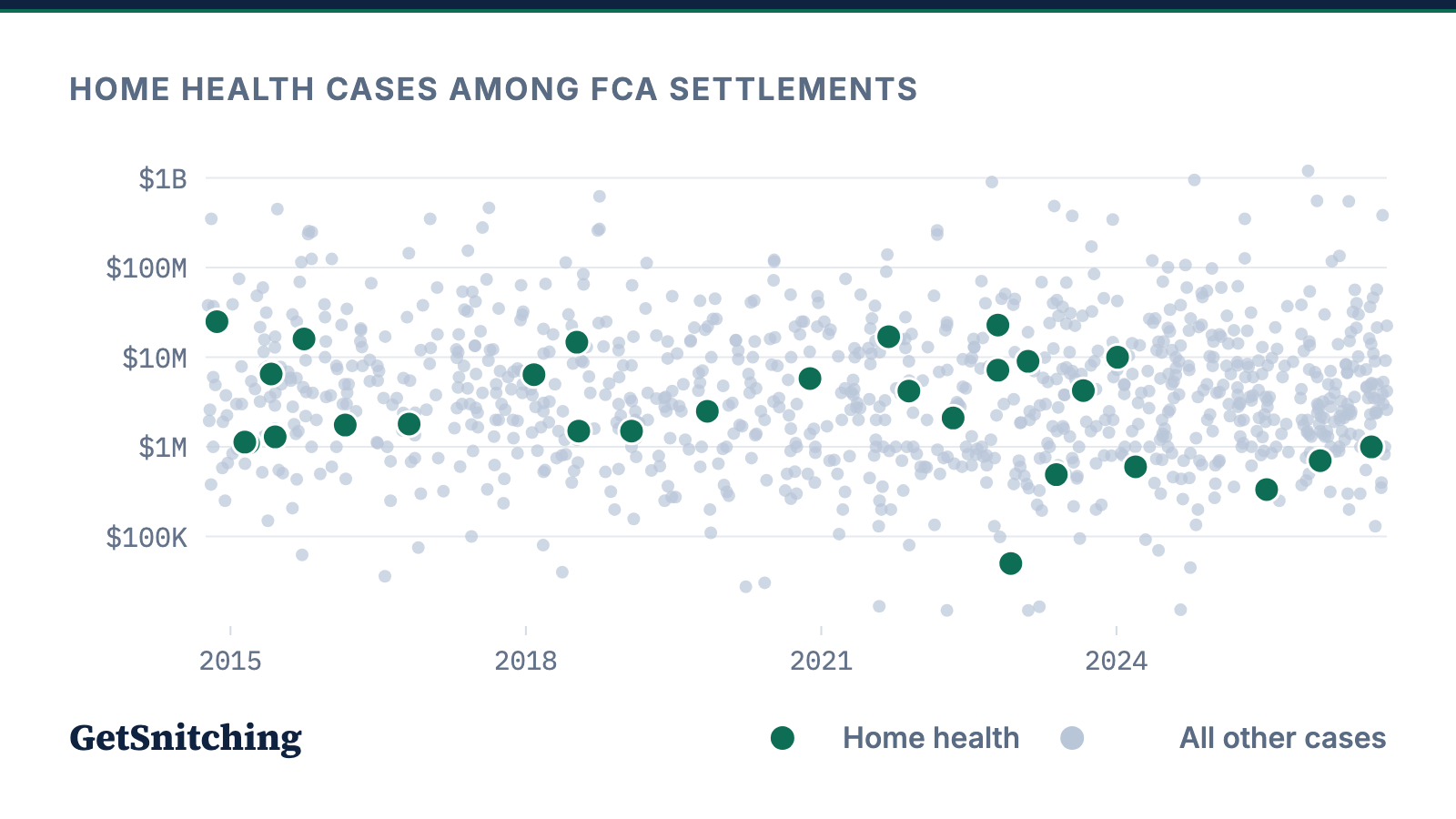
We read every home health False Claims Act settlement in our corpus of DOJ press releases from October 1, 2014 (the start of FY2015) through October 31, 2026. Twenty-eight were brought by whistleblowers and resolved, totaling about $167 million, with a median of $2.3 million and a range of $50,000 to $25 million. Two of them, together $16.2 million, also settled hospital or nursing facility claims. These are only the matters DOJ announced in press releases, a sample rather than every case.
Kickbacks dominate: 15 of the 28 alleged payments for referrals. Six alleged patients who were not homebound or lacked the required doctor’s certification, five alleged services not provided or time padded, and four alleged unnecessary or upcoded care. At least 14 releases identify the whistleblower as a current or former employee, among them a licensed practical nurse, therapists, a marketer, and a corporate administrator. Five examples:
- CareAll, $25 million (2014): one of Tennessee’s largest home health providers allegedly overstated how sick patients were and billed for patients who were not homebound. The whistleblower’s share was more than $3.9 million.
- BAYADA, $17 million (2021): the government alleged BAYADA bought two Arizona agencies from a retirement home operator as a kickback, to win referrals from its communities nationwide. The case was brought by BAYADA’s former director of strategic growth.
- Home Family Care, $6.4 million (2018): a Brooklyn agency allegedly billed Medicaid for aide services never provided and directed employees to get around its own system for verifying that aides were in patients’ homes.
- Signature HomeNow, $2.1 million (2022): Medicare was billed for Florida patients who were not homebound, lacked a valid plan of care, or had no face-to-face visit. DOJ says the matter arose from a complaint to the HHS-OIG hotline as well as a qui tam suit, a reminder that a hotline complaint can start a case.
- Blessings 4 Ever Home Care, $1 million (2026): falsified documentation for personal care attendants and the hospital-day billing described above. The whistleblower receives 21% of the federal recovery.
Settlements resolve allegations only, with no finding of liability. Browse the full set in our False Claims Act settlements database.
If you work for the agency
The False Claims Act protects any employee, contractor, or agent who is fired, demoted, threatened, or harassed for lawful efforts to stop a violation or to pursue a False Claims Act case. Remedies include reinstatement, two times back pay with interest, special damages, and attorney fees, and the suit must be filed within three years of the retaliation (31 U.S.C. 3730(h)). The DOJ rewards program offers no job protection of its own. Read False Claims Act retaliation, and how to report fraud anonymously before deciding whether to put your name on a report.
What to write down
Keep a dated record on a personal device, limited to what your job already lets you see:
- each patient affected (name or initials), dates of care, and whether they leave home and how often;
- scheduled visits or shifts against what actually happened, including days the patient was in the hospital;
- how EVV or timesheets were handled: who clocked in, from where, and any after-the-fact edits;
- who signed the plan of care and whether that doctor ever saw the patient;
- payments, gifts, or jobs tied to referrals;
- for families, the Medicare Summary Notice or Medicaid statement listing visits billed.
Do not remove records you are not authorized to take; describe where they are, because the reward terms exclude illegally obtained information. The Fraud Tip Builder has a home health checklist. If the patient is in hospice instead, see how to report hospice fraud; for telehealth visits, unordered equipment, or genetic test kits, see how to report telehealth and billing fraud.
Not legal advice
GetSnitching explains programs and processes in plain English from official sources. Whistleblower and reporting decisions can carry real legal risk. For advice about your situation, talk to a licensed attorney. Many whistleblower attorneys offer free consultations.
Official sources
- Report Fraud, Waste, and Abuse (HHS Office of Inspector General)
- Other Ways to Contact the Hotline (HHS-OIG)
- Disclosing Your Identity (HHS-OIG Hotline)
- Alert: Improper Arrangements and Conduct Involving Home Health Agencies and Physicians (HHS-OIG, June 22, 2016)
- Medicaid Fraud Control Units (HHS-OIG)
- Medicaid Fraud Control Units Annual Report: Fiscal Year 2025, OEI-09-26-00140 (HHS-OIG, March 2026)
- Home health services coverage (Medicare.gov)
- Reporting Medicare fraud and abuse (Medicare.gov)
- Filing complaints about a doctor, hospital, or provider (Medicare.gov)
- Getting a fast appeal from non-hospital settings (Medicare.gov)
- State Survey Agency contact information (CMS)
- Electronic Visit Verification (Medicaid.gov)
- 42 U.S.C. 1396b(l), electronic visit verification (Cornell LII)
- Adult Protective Services, What You Must Know (ACL fact sheet)
- Contact Us: abuse, neglect, and exploitation (Administration for Community Living)
- Fraud Division Rewards Program, External Guidance Terms and Conditions (DOJ)
- Fraud Division Rewards Program, Frequently Asked Questions (DOJ)
- Report fraud, waste, or abuse (America.gov)
- 31 U.S.C. 3730, Civil actions for false claims (Cornell LII)
- CareAll Companies Agree to Pay $25 Million (DOJ, November 12, 2014)
- Brooklyn-based home health care service agrees to pay over $6.4 million (DOJ, E.D.N.Y., January 31, 2018)
- BAYADA to Pay $17 Million (DOJ, September 8, 2021)
- Home health company operating in Florida pays $2.1 million (DOJ, W.D. Ky., May 5, 2022)
- Philadelphia in-home care services provider agrees to pay $1 million (DOJ, E.D. Pa., August 4, 2026)
- Home health agency and former owner to pay $5.8 million (DOJ, November 20, 2020)
- Home healthcare company agrees to pay nearly $10 million, Energy Employees program (DOJ, January 5, 2024)
- Home healthcare company pays $9 million, Energy Employees program (DOJ, S.D. Ohio, February 7, 2023)
- Home health care provider to pay $334,807 (DOJ, E.D. Mich., July 11, 2025)
- DOJ press releases API (corpus of False Claims Act settlement releases, FY2015 to October 31, 2026)