Does Medicare pay a reward for reporting fraud? Up to $1,000
Verified against official sources:
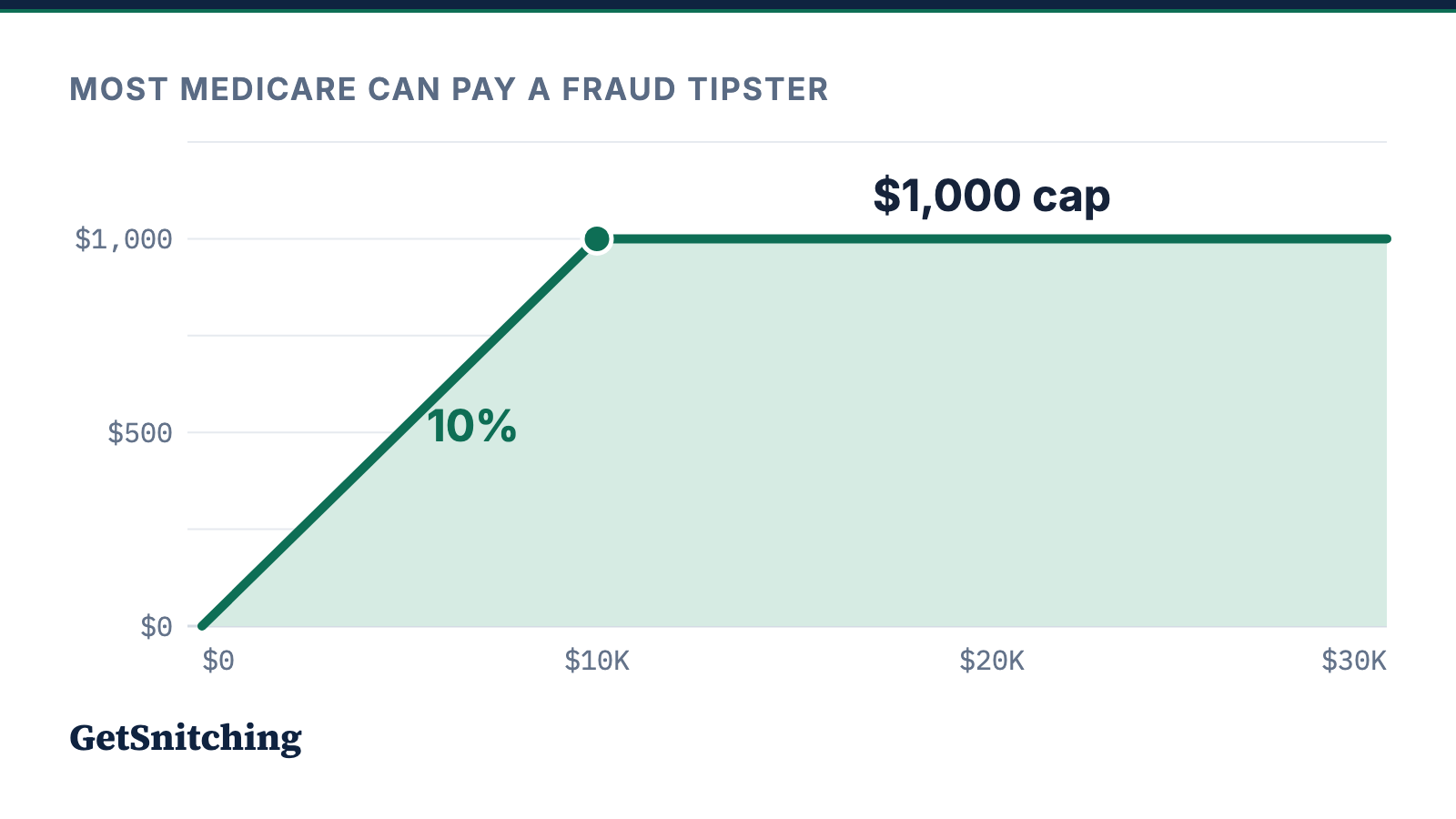
Yes, but the reward Medicare itself offers is small. Under the Medicare Incentive Reward Program, the most the Centers for Medicare & Medicaid Services (CMS) can pay for a fraud tip is 10 percent of the overpayments it recovers or $1,000, whichever is less. The payment is at CMS’s discretion, and CMS has said that very few have ever been paid. The large sums people read about come from a different route, a False Claims Act lawsuit, which pays a percentage of what the government recovers. Here is what each one says.
The Medicare Incentive Reward Program: $1,000 at most
The rule is 42 CFR 420.405. We read the current text on November 9, 2026. It says CMS pays a monetary reward for information that leads to the recovery of at least $100 of Medicare funds from a person or company that committed sanctionable fraud or abuse. It then sets the limits:
- The cap. The reward is whatever CMS considers adequate, “not to exceed 10 percent of the overpayments recovered in the case or $1,000, whichever is less.” If several people qualify in one case, they split that one amount.
- Discretion. Whether a person qualifies, and for how much, is up to CMS. The rule says no person may promise a reward on CMS’s behalf.
- Only recovered Medicare money counts. Fines and penalties do not count toward the 10 percent.
- New information only. There is no reward if the provider was already under review or investigation by CMS, its contractors, HHS-OIG, the Justice Department, the FBI, or any other law enforcement agency when you reported.
- Specifics required. The tip must concern a specific person or company and give the time period.
- Payment comes last. CMS pays only after it has collected all overpayments, fines, and penalties in the case, and it pays only if no other law already provides a reward.
Some people cannot be paid at all: employees of HHS, its contractors, the Social Security Administration, state Medicaid agencies, and law enforcement agencies, and their immediate family members; other federal or state employees and contractors, and HHS grantees, who learned the facts in the course of their official duties; anyone who obtained the information illegally; and anyone who took part in the fraud.
How often it pays
Rarely. In a 2013 proposal, CMS wrote that since the program began operating in July 1998, “only 18 rewards have been paid, for a total of less than $16,000.” CMS proposed raising the reward to 15 percent of amounts collected. In its December 2014 final rule it did not adopt that change, saying it “may finalize” it in future rulemaking. The $1,000 cap is still the text in force today. CMS has not published newer payment figures that we could find.
You cannot be considered if you report anonymously
There is no claim form. The rule says a person “interested in receiving a reward” must give a name, address, and telephone number when reporting, and may report to the HHS Office of Inspector General or to the Medicare contractor that handles the provider’s claims. If CMS decides you qualify, it writes to the last address you gave. An unclaimed reward lapses one year after CMS first tries to notify you. The rule also says CMS does not reveal a participant’s identity except as required by law.
The OIG hotline’s own pages do not mention a reward, and the hotline says it cannot confirm receipt of a complaint or give status updates.
The route that pays a percentage: the False Claims Act
The False Claims Act lets a private person sue on the government’s behalf over false claims for federal money, which includes false Medicare billing. If the case recovers money, 31 U.S.C. 3730(d) sets the share for the person who brought it:
- 15 to 25 percent of the proceeds if the government takes over the case.
- 25 to 30 percent if the government declines and the person wins or settles it without the government.
- No more than 10 percent if the court finds the case was based primarily on information that was already public.
A court can reduce the share of a person who planned and started the fraud, and a person convicted for their part in it gets nothing.
This is a lawsuit filed in federal court. A call to a hotline does not start one, and many cases recover nothing. Our False Claims Act page and the plain-English guide to qui tam lawsuits explain how it works.
A newer flat reward from the Justice Department
The Justice Department’s fraud tip rewards program is a pilot that offers $10,000 to $30,000 for a tip that leads to unsealed federal criminal charges. Federal health care offenses are one of its covered areas. Its FAQ was last updated October 20, 2026. Payment is in the Department’s sole discretion, and it says it may deny an award solely because a tip did not come through its portal at america.gov/fraud. Our guide to that portal covers the steps.
How to report
- Medicare fraud by a provider or supplier: HHS-OIG, online or at 1-800-HHS-TIPS (1-800-447-8477). See our HHS-OIG hotline page for what to include.
- Suspected fraud on your own Medicare statement: Medicare, at 1-800-MEDICARE (1-800-633-4227). For telehealth calls, unordered test kits, or billing for care you never got, see how to report telehealth and billing fraud.
- Medicaid fraud: your state’s Medicaid Fraud Control Unit, listed on our state pages. Who investigates Medicaid and Medicare fraud explains what happens next.
Protect yourself first
If you are reporting your own employer, the False Claims Act bars retaliation against employees, contractors, and agents who try to stop false claims. Under section 3730(h), relief includes reinstatement and two times the amount of back pay, and a retaliation suit must be filed within 3 years.
Not legal advice
GetSnitching explains programs and processes in plain English from official sources. Whistleblower and reporting decisions can carry real legal risk. For advice about your situation, talk to a licensed attorney. Many whistleblower attorneys offer free consultations.
Official sources
- 42 CFR 420.405, Rewards for information relating to Medicare fraud and abuse (eCFR, current through 11/6/2026)
- Proposed rule, Medicare Incentive Reward Program (CMS, 78 FR 25013, April 29, 2013)
- Final rule, Medicare Incentive Reward Program and Provider Enrollment (CMS, December 5, 2014)
- 31 U.S.C. 3730, False Claims Act civil actions (awards at 3730(d), retaliation at 3730(h))
- Report Fraud, Waste, and Abuse (HHS Office of Inspector General)
- Reporting Medicare fraud and abuse (Medicare.gov)
- Criminal Tip Rewards Pilot Program FAQs (U.S. Department of Justice, updated October 20, 2026)