PPP loan fraud whistleblower rewards: what reporting pays and where to report
Verified against official sources:
Yes, reporting PPP or EIDL loan fraud can pay, through two routes. The DOJ Fraud Rewards Program (WHIP) pays a flat $10,000 to $30,000 per tip when it leads to criminal charges that are unsealed, and Small Business Administration programs are on its covered list. A qui tam case under the False Claims Act pays 15% to 30% of what the government recovers in a civil case, filed under seal through a lawyer. The SBA Inspector General hotline, the standard place to report PPP fraud, pays nothing at all. If you know a business padded its headcount, invented payroll, or spent the money on itself, the free Fraud Tip Builder checks which route fits and writes your tip for you.
Route 1: WHIP, $10,000 to $30,000 at charges
DOJ’s terms cover fraud on “programs or benefits administered by” the SBA, which includes PPP and COVID EIDL loans. You must be an individual, not a company. The tip must be voluntary, truthful, and original, meaning based on your own knowledge or your own analysis rather than repeating a news story or court filing. There is no minimum loss amount.
Payment comes “at or around the time charges are filed,” once an indictment, information, or criminal complaint is unsealed. You do not wait for a conviction. Each distinct tip can earn one reward, and if two people send the same information, only the first qualifies. The amount is in DOJ’s sole discretion and cannot be appealed, and the program is a pilot with an initial three-year term.
File through the signed intake form at america.gov/fraud. The FAQ says DOJ may deny a reward solely because a tip came in through another channel, so a report to the SBA hotline alone does not put you in line for this money.
The catch for PPP: WHIP pays only when there are criminal charges. Many PPP cases end in civil settlements instead, which pay under the second route but not this one.
Route 2: qui tam, 15% to 30% of the recovery
Under 31 U.S.C. 3730(d), a whistleblower (the “relator”) receives 15% to 25% of the proceeds when the government takes over the case, 25% to 30% when it declines and the relator’s lawyer litigates alone, and no more than 10% in a government-led case based primarily on publicly disclosed information. The base can be large, because the False Claims Act lets the government recover three times its damages plus a penalty for each false claim. The complaint stays sealed for at least 60 days and in practice requires a lawyer.
DOJ’s own releases show what PPP relators have received:
- Victory Automotive Group, $9 million. The company certified fewer than 500 employees while sharing control with dozens of dealerships employing more than 3,000. The whistleblower received about $1.62 million. (DOJ release)
- Patrick Walsh and 10 companies, $20 million consent judgment. Walsh admitted to false employee rosters and payrolls, some companies were dormant, and loan money went to personal purposes including a private island. The relator performed IT services for Walsh; his share had not been determined when DOJ announced the judgment. (DOJ release)
- Cosmax USA, $6 million. Alleged: a loan amount partly based on temporary workers who were not its employees, and a false certification of fewer than 300 employees for a second-draw loan. The relator was the company’s controller, who also worked in human resources. (DOJ release)
- Mount Zion Baptist Church, $70,464.39. Alleged: PPP money used for mortgage principal payments, which the program did not allow, then certified as eligible for forgiveness. A former employee received $10,569.66. (DOJ release)
That last case is the honest floor: a small misuse produces a small share, and a lawyer may not take it. For how the two routes interact, read WHIP vs qui tam.
What DOJ’s PPP settlements look like
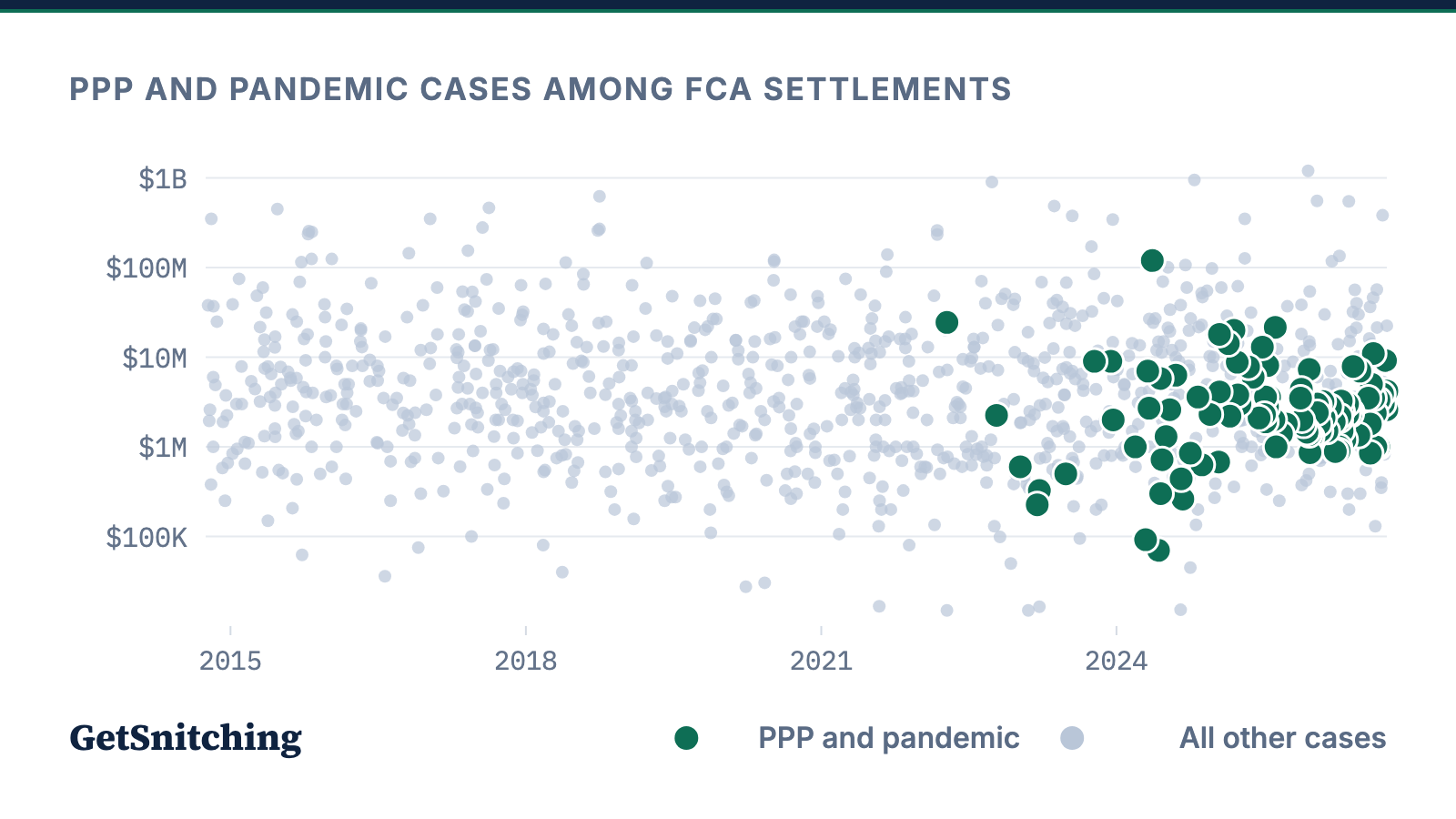
Our False Claims Act settlements database holds 103 resolved PPP and pandemic-relief cases that DOJ announced in press releases, each with the amount stated in DOJ’s headline. A few involve other pandemic programs, such as airline payroll support, rather than PPP loans. These are the cases DOJ chose to announce, not every case: DOJ itself reports about 840 settlements and judgments in SBA pandemic-relief programs, totaling more than $850 million.
| Fiscal year | Announced cases |
|---|---|
| FY2022 | 1 |
| FY2023 | 5 |
| FY2024 | 17 |
| FY2025 | 28 |
| FY2026 | 52 |
The median case was $2.3 million. The total was $507 million, of which up to $120 million is a single settlement with Kabbage, a lender rather than a borrower. Seventeen cases were under $1 million, 64 fell between $1 million and $5 million, and 22 were $5 million or more. Filter the database by the “PPP and pandemic relief” sector to see every one.
The allegations are narrower than “PPP fraud” suggests. We read the full text of 98 of these releases that concern PPP loans. More than half involved size rules: a company that certified it was under the employee limit (generally 500 for a first-draw loan, 300 for a second draw) without counting affiliates, often a foreign parent. About a dozen involved organizations that were not eligible at the time, such as private clubs. Fewer involved spending the money on the wrong things, owners who hid a disqualifying criminal record, or invented payroll.
Many PPP relators are data companies
Most of those 98 PPP releases do not describe an employee. In 51 of them, the relator named is a company or LLC. One, GNGH2 Inc., appears in 30; in the YAPP USA settlement for $14.2 million, it received $1,420,849 (DOJ release). DOJ’s April 2026 FOCUS paper says the SBA’s public release of loan data “fueled qui tam complaints filed by data miners,” that data miners have filed more than 45% of all qui tams since fiscal 2024, and that more than three quarters of SBA pandemic settlements came from cases DOJ started itself, “suggesting a lower overall success rate” for data-mined suits.
The legal reason is the public disclosure bar. Under 31 U.S.C. 3730(e)(4), a court must dismiss a qui tam, unless the government objects, if substantially the same allegations were already disclosed in a federal report, hearing, or audit, or in the news media. The exception is an “original source”: an individual whose knowledge is independent of and materially adds to what was public. In a 2026 PPP case, the Ninth Circuit assumed the public PPP data on PandemicOversight.gov counts as a federal report. The relator’s claim survived because the data alone did not show the loan was improper: SBA exceptions made some businesses of that type eligible, so more facts were needed. The court still agreed that its headcount theory, built on the square footage of one office, failed to state a plausible claim (Relator, LLC v. Erskine).
In plain words: if your case is only what anyone can download, a court may bar it, and if you are the first to file, a data company may already have done so. An employee who saw the real payroll has exactly what the dataset lacks.
What makes a PPP tip strong
The strongest tips put the loan application next to the truth:
- Employee count. How many people the business claimed, against how many actually worked there, including sister companies and any parent. Second-draw borrowers also had to show a 25% drop in gross receipts.
- Payroll. Loan amounts were calculated from payroll costs; second-draw loans were generally capped at 2.5 times average monthly payroll. Payroll reports, W-2 counts, or a roster that does not match the application are the core evidence.
- Use of funds. PPP money could go to payroll, mortgage interest, rent, utilities, and a few other listed costs. Owner purchases, debt payoffs, or mortgage principal are not on the list.
- Forgiveness. The forgiveness application is a separate certification. Wages claimed for people who did not work there, or spending certified as eligible when it was not, are separate false claims.
- Eligibility. A dormant company, a hidden criminal record, or an ineligible type of organization.
Use only records you were entitled to see. WHIP’s terms say information obtained illegally gives you no protection from prosecution. The Fraud Tip Builder structures these facts into the fields the federal portal asks for.
Deadlines
Congress gave PPP and COVID EIDL fraud a 10-year limit for criminal charges and civil enforcement actions alleging borrower fraud. PPP closed on May 31, 2021, so the earliest 2020 applications reach that line in 2030. The False Claims Act’s general limit is 6 years from the violation, or 3 years after the responsible official knew, capped at 10. The practical deadline is sooner: under the first-to-file rule, once one relator files, no one else can bring a related action, and WHIP pays only the first person to send the same information.
Retaliation and anonymity
If you are an employee, contractor, or agent, the False Claims Act’s section 3730(h) entitles you to reinstatement, two times back pay, and special damages if you are punished for lawful steps to stop a violation, with 3 years to sue. WHIP creates no protection of its own.
The SBA Inspector General does not require your name, treats your identity as confidential by default, and gives no updates. WHIP allows anonymity only through an attorney, and you must identify yourself before payment. A qui tam complaint carries your name and is sealed only until the court lifts the seal.
Where to report
- An insider with documents and a large loan: talk to a qui tam lawyer before filing anything public, to protect your first-to-file position.
- Anyone else with specific facts: submit a WHIP tip at america.gov/fraud, built with the Fraud Tip Builder.
- Also, or if a reward does not matter: the SBA Inspector General’s online complaint system, which no longer takes complaints by phone or email.
Not legal advice
GetSnitching explains programs and processes in plain English from official sources. Whistleblower and reporting decisions can carry real legal risk. For advice about your situation, talk to a licensed attorney. Many whistleblower attorneys offer free consultations.
Official sources
- Fraud Division Rewards Program, External Guidance Terms and Conditions (DOJ, updated October 20, 2026)
- Criminal Tip Rewards Pilot Program, Frequently Asked Questions (DOJ, updated October 20, 2026)
- Report fraud (America.gov)
- Office of Inspector General Hotline (U.S. Small Business Administration)
- Paycheck Protection Program (U.S. Small Business Administration)
- 31 U.S.C. 3729, False claims
- 31 U.S.C. 3730, Civil actions for false claims
- 31 U.S.C. 3731, False claims procedure
- Public Law 117-166, PPP and Bank Fraud Enforcement Harmonization Act of 2022
- Public Law 117-165, COVID-19 EIDL Fraud Statute of Limitations Act of 2022
- Fact Sheet, False Claims Act Settlements and Judgments, FY2025 (DOJ)
- FOCUS Initiative for Data Miners Filing Qui Tam Complaints (DOJ Civil Division, April 30, 2026)
- United States ex rel. Relator, LLC v. Erskine, No. 25-2073 (9th Cir. July 15, 2026)
- Victory Automotive Group Inc. Agrees to Pay $9 Million (DOJ)
- Florida Businessman Patrick Walsh and Affiliated Companies Agree to $20M Consent Judgment (DOJ)
- Former Solon-based Manufacturer to Pay $6M (DOJ, N.D. Ohio)
- Mount Zion Baptist Church Agrees to Pay Over $70,000 (DOJ, M.D. Tenn.)
- Subsidiary of Chinese State-Owned Entity to Pay $14.2M (DOJ)