Is there a reward for reporting money laundering? Not paid yet
Verified against official sources:
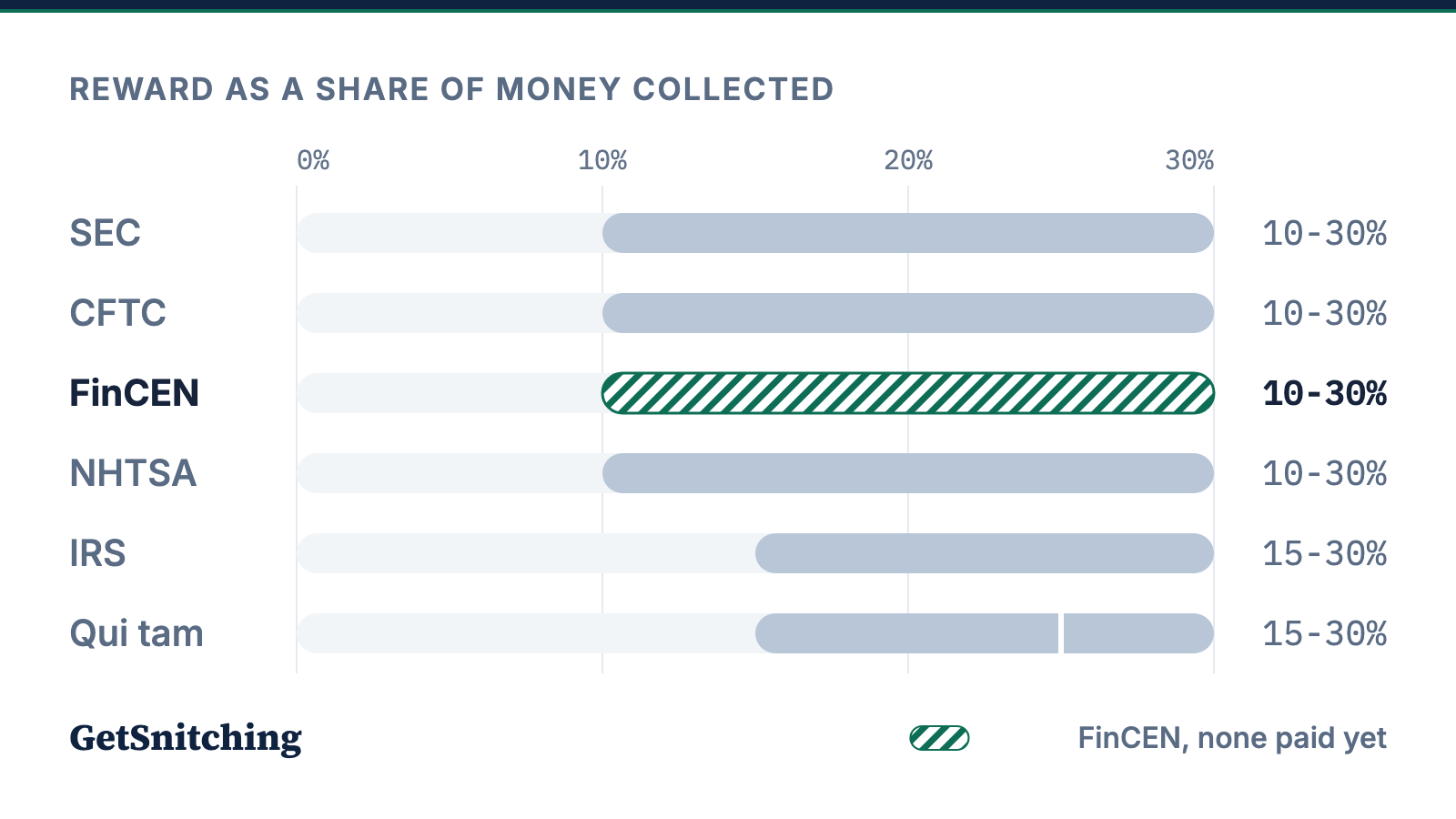
Yes in law, not yet in practice. A federal statute, 31 U.S.C. 5323, says the Treasury Department “shall pay” 10 to 30 percent of the money collected when a whistleblower’s information leads to a money laundering or sanctions case with penalties over $1 million. But the agency that runs the program, the Financial Crimes Enforcement Network (FinCEN), has not finished the regulation it says it needs. Its website says that once the regulation is finalized, FinCEN “will begin processing and paying awards.” As of November 9, 2026 there is no final rule, and FinCEN’s program pages report no award paid.
You can still submit a tip today. Here is what the law promises, what is missing, and what protects you in the meantime.
What the law covers
FinCEN’s program takes information about violations, or conspiracies to violate, four laws:
- The Bank Secrecy Act (BSA), the law behind anti-money-laundering duties such as filing suspicious activity reports.
- The International Emergency Economic Powers Act (IEEPA).
- The Trading With the Enemy Act (TWEA).
- The Foreign Narcotics Kingpin Designation Act.
FinCEN describes the last three as the laws behind U.S. trade and economic sanctions, so the program reaches both money laundering and sanctions evasion. Congress created it in the Anti-Money Laundering Act of 2020 and amended it in the Anti-Money Laundering Whistleblower Improvement Act of 2022.
What the law says it pays
Under section 5323, an award is due when a whistleblower voluntarily provides original information that leads to a successful case by the Treasury Department or the Justice Department, and the case results in monetary sanctions exceeding $1,000,000. The award is not less than 10 percent and not more than 30 percent of what has been collected, shared among all the whistleblowers in the case. The amount inside the range is at the Treasury Secretary’s discretion.
Three details in the statute change the math:
- Forfeiture does not count. “Monetary sanctions” means penalties, disgorgement and interest. The statute excludes forfeiture, restitution and victim compensation payments. A case that ends mostly in forfeited assets may produce little or nothing to take a percentage of.
- Collected, not ordered. As with the SEC and CFTC programs, the percentage applies to money actually collected.
- Internal reports count. Unlike most reward laws, this one covers information given to your employer, “including as part of the job duties” of the person reporting, as well as information given to Treasury or the Justice Department.
Awards are to be paid from a Treasury account called the Financial Integrity Fund, filled by collected sanctions.
Who cannot get an award
The statute bars an award to anyone who:
- Was an employee of a regulatory or banking agency, the Treasury or Justice Department, or a law enforcement agency, and got the information in the normal course of that job.
- Is convicted of a crime related to the case.
- Does not submit the information in the form the rules require.
- Knowingly makes a false statement or uses a false document.
Where the rule stands
This is the part that decides whether anyone is paid.
- FinCEN published a proposed rule, “Whistleblower Incentives and Protections,” in the Federal Register on April 1, 2026. The comment period closed June 1, 2026.
- No final rule has been published since. FinCEN’s Program Updates page lists the proposed rule and two bulletins from 2026, and nothing after them on rulemaking.
- FinCEN’s program page still reads: “Once that regulation is finalized, FinCEN will begin processing and paying awards.”
FinCEN’s program pages give no count of tips received or awards approved, and no date for the final rule. Nobody outside the agency can tell you when the first award will be paid or how large it will be.
How to report
FinCEN accepts tips now through the Submit a Tip button on its Submitting a Tip page. Its Office of the Whistleblower confirms receipt and sends a reference number. Keep that number.
FinCEN asks for names and contact details of the people and companies involved, the full facts, how you learned of them, what evidence you hold and where other evidence is, and the dollar amount at issue if you know it. It also says recent events are easier to investigate, so sooner is better.
You may submit anonymously, including through an attorney. Under the statute, a person who claims an award anonymously must be represented by counsel, and must disclose their identity to Treasury before any award is paid.
If the conduct also involves unpaid tax, the IRS lists money laundering and the Bank Secrecy Act among the areas its own award program covers; see does the IRS pay for reporting tax fraud. If it involves securities, see does the SEC pay whistleblowers. Both of those programs are paying awards now.
Our FinCEN whistleblower program page tracks the rulemaking and the filing steps.
Protect yourself first
The retaliation protection does not wait for the final rule. Section 5323(g) already makes it illegal for an employer to fire, demote, suspend, threaten, blacklist or harass you for reporting these violations to Treasury, the Justice Department, a regulator, Congress, or a supervisor at work.
The deadline is short: OSHA’s chart of whistleblower laws gives 90 days from the retaliation to file a complaint with the Department of Labor. Relief includes reinstatement, two times back pay with interest, and attorney fees. One gap matters for bank staff. This section does not apply to employers already covered by the separate bank and credit union whistleblower laws, 12 U.S.C. 1831j, 1790b and 1790c. See our Anti-Money Laundering Act protection page for who is covered and how to file.
Not legal advice
GetSnitching explains programs and processes in plain English from official sources. Whistleblower and reporting decisions can carry real legal risk. For advice about your situation, talk to a licensed attorney. Many whistleblower attorneys offer free consultations.
Official sources
- 31 U.S.C. 5323, whistleblower incentives and protections
- FinCEN Whistleblower Program
- FinCEN Whistleblower Program Updates
- FinCEN: Submitting a Tip
- Federal Register: Whistleblower Incentives and Protections, proposed rule (April 1, 2026)
- FinCEN: Anti-Retaliation Protections
- Whistleblower Statutes Summary Chart (OSHA, updated 5/13/2026)