Does the IRS pay for reporting tax fraud? Yes, 15% to 30%
Verified against official sources:
Yes. Federal law lets the IRS pay people who report tax fraud or unpaid tax, and in large cases the award is required: at least 15 percent and not more than 30 percent of the money the IRS collects because of the information. Three things decide whether a report can ever turn into a payment. The IRS has to act on it, the IRS has to actually collect, and the claim has to be signed with your name. An anonymous tip can still be sent to the IRS, but it cannot earn an award.
What the law says the IRS pays
The reward law is 26 U.S.C. 7623. It has two parts.
Large cases, section 7623(b). If the IRS proceeds with an action based on your information, you “shall” receive 15 to 30 percent of the proceeds collected. This part applies only when the proceeds in dispute exceed $2,000,000. If the person you report is an individual and not a business, that person’s gross income must also exceed $200,000 in at least one tax year at issue. Proceeds include tax, penalties, interest, criminal fines and civil forfeitures.
Everything smaller, section 7623(a). Below those thresholds, the statute only says the IRS “is authorized to pay such sums as he deems necessary.” There is no minimum. The IRS says it will consider these claims for a discretionary award.
The percentage can also drop. If the case rests mainly on facts that were already public, such as a court hearing, a government report or the news, the award is capped at 10 percent unless you were the original source. If you planned and initiated the tax scheme yourself, the IRS may reduce the award, and it must deny it if you are convicted for that role.
Who cannot get an award
The IRS lists these groups as not eligible to submit a claim:
- Treasury Department employees, including former employees who got the information while working there.
- Federal employees who learned the information through their official duties.
- People required by federal law to disclose the information, or barred by federal law from disclosing it.
- Federal contractors who got the information through the contract.
Anyone who reports anonymously is also out. The statute says no award may be made unless the information is submitted under penalty of perjury, and the IRS states that anonymous tips do not qualify for a claim for award.
What the IRS actually paid
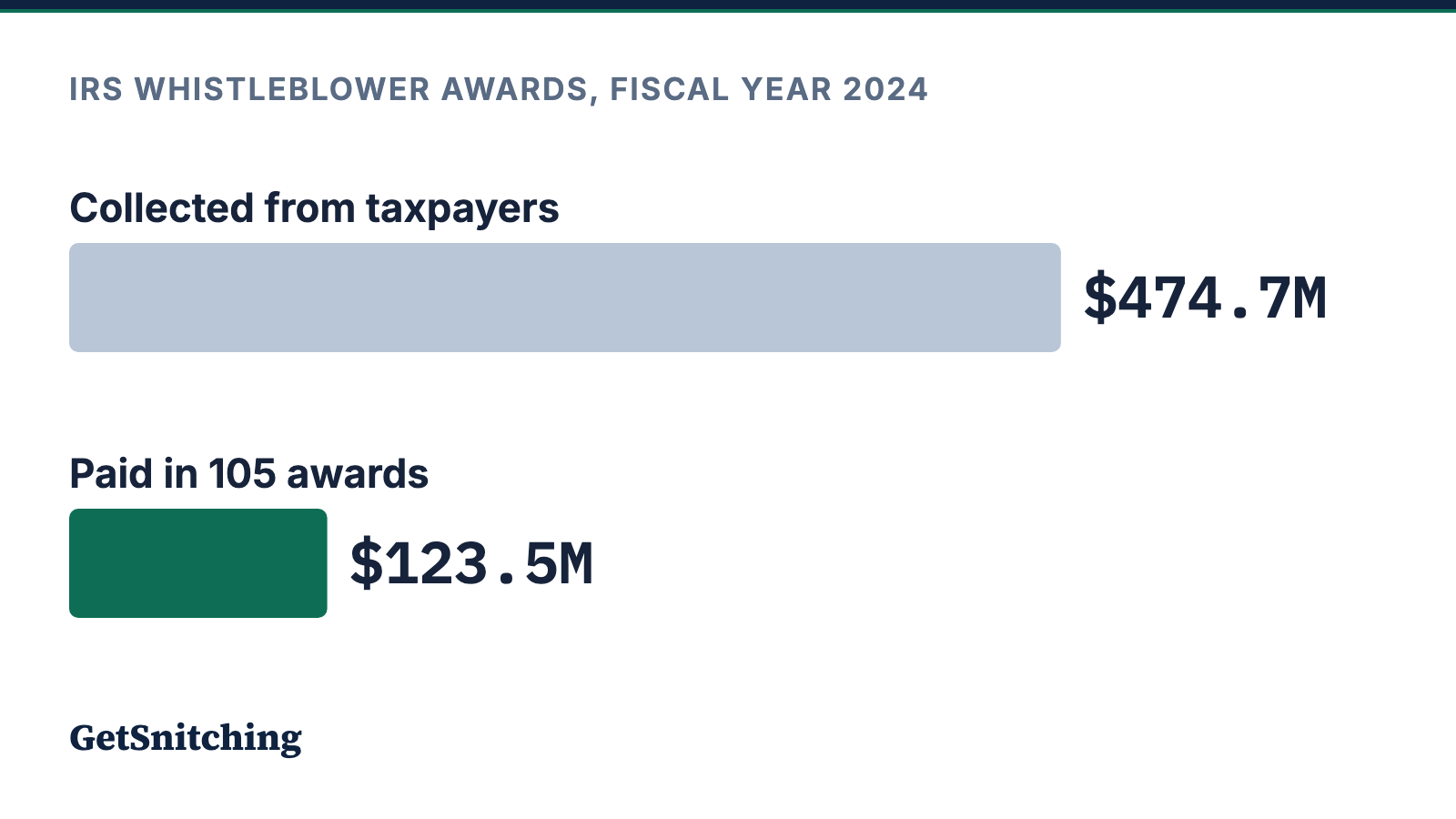
The most recent annual report the IRS has published covers fiscal year 2024. In that year the Whistleblower Office paid 105 awards totaling $123.5 million, on $474.7 million collected. Two details from the same report matter more than the headline:
- Large 7623(b) claims were about 20 percent of the award payments but more than 97 percent of the dollars. The discretionary 7623(a) awards came to about $3.0 million in total.
- Awards are cut by federal budget sequestration before they are paid. The cut was 5.7 percent in fiscal year 2024.
The report also shows what happens when the taxpayer never pays. Claims closed in fiscal year 2024 had $38.3 million in assessments that went uncollected, and the IRS paid no awards on that money.
None of this predicts what a new claim will pay. The IRS’s own notices to whistleblowers repeat that a referral for audit, or even a payment by the taxpayer, “does not mean the claim will receive an award.”
How long it takes
Years. IRS Publication 5251 says a taxpayer’s administrative and court appeals “can take many years to resolve,” and that the IRS can only pay from proceeds it has collected. If the taxpayer does not or cannot pay, the Whistleblower Office waits for the collection period to expire before it decides the claim.
If you disagree with an award decision in a 7623(b) case, the statute gives you 30 days to appeal to the Tax Court.
How to report
To claim an award, file Form 211, Application for Award for Original Information. As of November 2026 the IRS takes Form 211 online through its whistleblower portal, linked from its claim submission page. You will need the name and address of the person or business, a specific description of the violation, how and when you learned of it, any documents you have, your relationship to the subject, and your own contact information, signed under penalty of perjury. Our Form 211 guide goes through it section by section, and the IRS whistleblower program page covers the full process.
If you do not want an award, or do not want to give your name, the IRS takes tips on Form 3949-A, Information Referral. That route can be anonymous. It pays nothing.
Protect yourself first
The IRS says it protects a whistleblower’s identity to the fullest extent the law allows. That is confidentiality, not anonymity: the IRS knows who you are.
If you report your own employer, section 7623(d) makes it illegal to fire, demote, suspend, threaten or harass you for it. The deadline is short. A retaliation complaint must be filed with the Department of Labor within 180 days of the retaliation, and it is a separate filing from Form 211. Remedies include reinstatement and 200 percent of back pay. See our Taxpayer First Act protection page for how to file, and how much whistleblowers get paid to compare this program with the others.
Not legal advice
GetSnitching explains programs and processes in plain English from official sources. Whistleblower and reporting decisions can carry real legal risk. For advice about your situation, talk to a licensed attorney. Many whistleblower attorneys offer free consultations.
Official sources
- 26 U.S.C. 7623, awards for detecting underpayments and fraud
- Submit a whistleblower claim for award (IRS, reviewed Nov. 6, 2026)
- IRS Whistleblower Office (reviewed Nov. 9, 2026)
- IRS Whistleblower Office Annual Report, Fiscal Year 2024 (Publication 5241, Rev. 5-2025)
- The Whistleblower Claim Process (IRS Publication 5251, Rev. 8-2026)
- Report tax fraud, a scam or law violation (IRS, reviewed Oct. 22, 2026)
- Whistleblower Statutes Summary Chart (OSHA, updated 5/13/2026)