Can your boss take your tips? What federal law says about managers, tip pools, and the $2.13 wage
Verified against official sources:
No. Under the federal Fair Labor Standards Act, your employer cannot keep any part of your tips, for any purpose, either directly or through a tip pool. That rule applies whether or not your employer pays you the reduced tipped wage, and even if you are paid the full federal minimum wage in cash. Here is what the U.S. Department of Labor’s Fact Sheet #15 says the law allows and forbids, including the $2.13 tipped wage and the difference between a tip and a service charge, and what to do if your tips are being taken.
Managers and supervisors cannot share in your tips
Fact Sheet #15 says an employer may not require you to hand tips to the employer, a supervisor, or a manager. A manager or supervisor, for this rule, is someone whose primary duty is managing the business or a department, who regularly directs the work of at least two full-time employees or the equivalent, and who can hire or fire or whose recommendations on hiring and firing carry particular weight. Owners with at least a 20 percent stake who actively manage the business count too.
There is one narrow exception: a manager may keep tips customers give them directly for service they alone provided. A restaurant manager who waits on a table can keep that table’s tip, but cannot take a cut of the servers’ pool.
The $2.13 cash wage and the tip credit
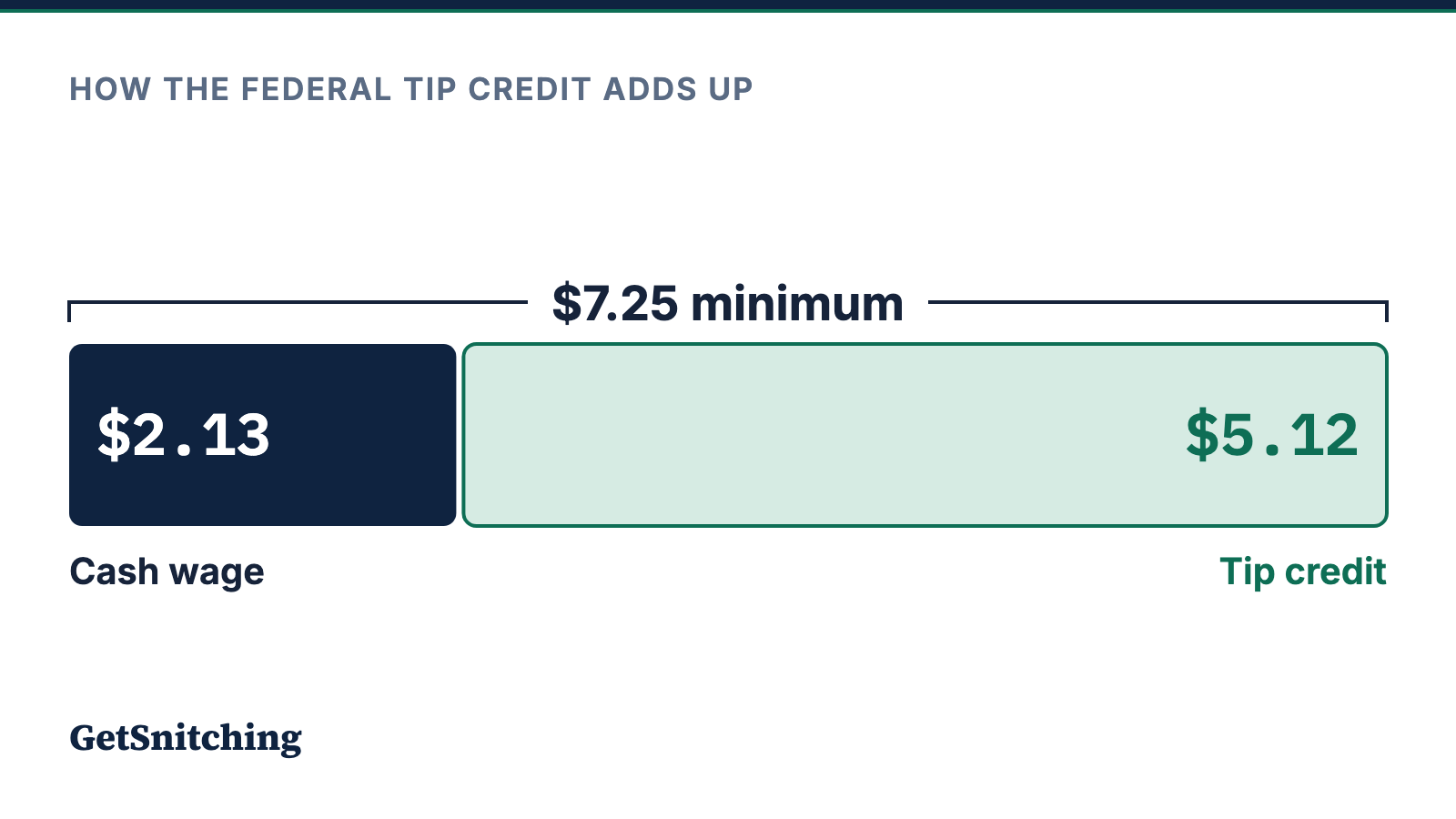
Federal law allows an employer to pay a tipped worker as little as $2.13 an hour in cash, counting the worker’s tips toward the rest of the $7.25 federal minimum wage. That arrangement is called a tip credit, and it comes with conditions. If your employer breaks them, it loses the right to the credit and owes you the difference.
The math. The most an employer can claim as a tip credit is the difference between $7.25 and $2.13: $5.12 an hour. Only tips you actually receive count, and the credit can never be more than the tips you got.
Your employer must make up any shortfall. In every workweek, your cash wage plus the tip credit must equal at least the full minimum wage. If your tips plus the cash wage come to less than $7.25 an hour for the week, your employer must pay the difference. A slow week does not let an employer pay you less than minimum wage.
The notice requirement. Before taking a tip credit, your employer must tell you, orally or in writing:
- the cash wage it is paying, which must be at least $2.13;
- the amount it is claiming as a tip credit, which cannot exceed $5.12;
- that the credit cannot exceed the tips you actually receive;
- that you keep all your tips, except through a valid tip pool limited to employees who customarily and regularly receive tips; and
- that the tip credit does not apply unless you have been told about these rules.
An employer that skips this notice cannot take the tip credit at all.
Who counts as a tipped employee. The Department of Labor treats a worker who customarily and regularly receives at least $30 a month in tips for a job as a tipped employee in that job. If you work two different jobs for the same employer, such as hotel maintenance and serving in the restaurant, the employer can take the tip credit only for the hours you work in the tipped job.
Tip pools are allowed, within limits
Your employer can require you to pool tips with coworkers, and federal law sets no cap on how much each person contributes. Who can be in the pool depends on what you are paid:
- If your employer takes a tip credit (pays less than the full minimum wage in cash and counts your tips toward the rest), the pool can include only employees who customarily and regularly receive tips, such as servers, bussers, bellhops, counter staff who serve customers, and service bartenders.
- If your employer pays everyone at least the full federal minimum wage in cash, the pool can also include workers who do not usually get tips, such as cooks and dishwashers.
Either way, the employer, managers, and supervisors cannot receive anything from the pool. Tips collected for a pool must be paid out by the regular payday.
Credit card tips
When customers tip by card, your employer may deduct only the actual percentage the card company charges on the transaction. If the card fee is 3 percent, you must get at least 97 percent of the tip. Taking more is unlawful keeping of tips. The tip must be paid by the regular payday, not held until the card company reimburses the employer.
Service charges are not tips
A charge the restaurant or venue adds to every bill, such as an automatic 18 percent for large parties, is not a tip. The Department of Labor says a compulsory charge for service, for example 15 percent of the bill, is not considered a tip under the FLSA. A tip belongs to the employee. A service charge belongs to the employer, which decides how much, if any, goes to staff. Customers often assume an automatic charge goes to the server; federal law does not require that.
If an employer passes service charge money to employees, that money is not tips. Instead, the Department of Labor says, it can be used to satisfy the employer’s minimum wage and overtime obligations. It is part of the employee’s total pay, and it must be included in the regular rate used to calculate overtime. That has two practical effects. First, an employer can keep some or all of a service charge without breaking the federal tip rules, because it was never a tip. Second, if it does pay the money out, it must count it when figuring your overtime rate.
If a customer pays the service charge and also leaves a tip on top, the extra tip is a real tip. It belongs to the employee and counts toward whether you are a tipped employee and toward any tip credit.
State law can be better
Many states have stronger tip laws, and where state law is more protective, the employer must follow it. Some states require a higher tipped cash wage than $2.13, and some do not allow a tip credit at all. Some do not allow any card-fee deduction from tips. Some states and cities require employers to disclose what a service charge is for or to pass it to workers. Our state wage theft pages name each state’s agency, which can tell you the rules where you work.
What you can recover
The FLSA makes an employer that unlawfully keeps tips liable for the tips it kept plus an equal additional amount as liquidated damages (29 U.S.C. 216(b)). For how that doubling works and when a lawsuit makes sense, see can you sue for unpaid wages?
How to report tip theft
File with the U.S. Department of Labor’s Wage and Hour Division at 1-866-487-9243 if your employer or a manager is taking your tips, if you are being paid less than minimum wage once tips are counted, or if your employer takes a tip credit without the required notice. Keep a daily record of the tips you receive and what you are paid out. If service charges are involved, ask your employer in writing how they are distributed.
Not legal advice
GetSnitching explains programs and processes in plain English from official sources. Whistleblower and reporting decisions can carry real legal risk. For advice about your situation, talk to a licensed attorney. Many whistleblower attorneys offer free consultations.