Can you sue your employer for unpaid wages? Federal deadlines and double damages
Verified against official sources:
Yes. The federal Fair Labor Standards Act gives workers the right to sue an employer for unpaid minimum wages and unpaid overtime, and to recover more than just the wages. You also usually have a cheaper, faster option first: a wage claim with a government agency. Here is how the federal lawsuit works, based on the statute’s text.
What you can recover: double, plus fees
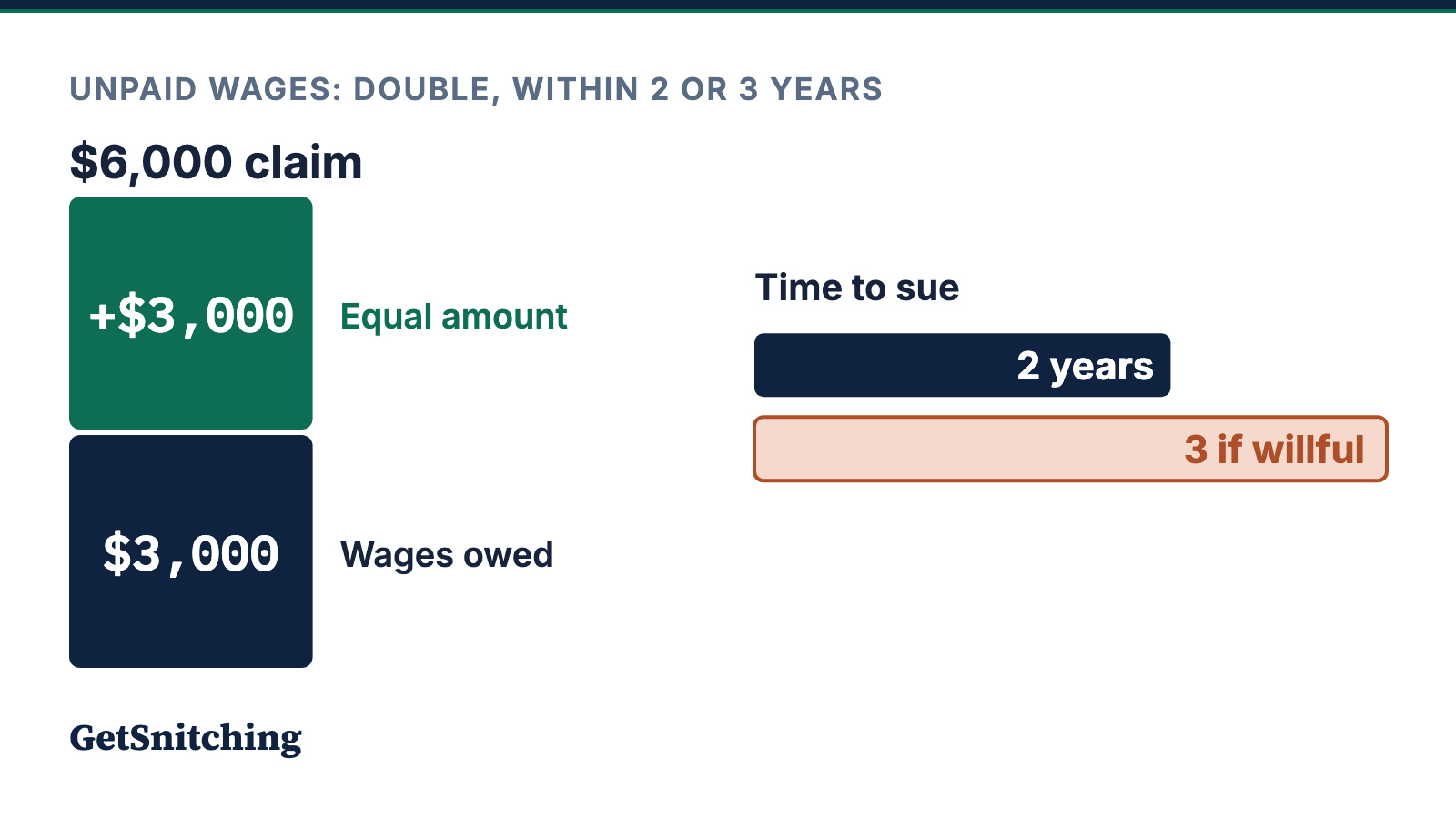
Under 29 U.S.C. 216(b), an employer that fails to pay the federal minimum wage or overtime is liable for the unpaid wages “and in an additional equal amount as liquidated damages.” In practice that means double: if you are owed $3,000 in overtime, the total claim is $6,000.
The same section applies the doubling to an employer that unlawfully keeps employees’ tips: it owes the tips plus an equal amount.
The court must also award reasonable attorney’s fees and costs to a worker who wins, paid by the employer. Liquidated damages and fee shifting together are why wage cases are often worth bringing even when the amount of pay is modest, and the fee rule is why many lawyers take wage cases without charging up front.
The deadline
Under 29 U.S.C. 255(a), a lawsuit must be filed within two years after the claim accrued, or within three years if the violation was willful. Each missed paycheck starts its own clock, so waiting means older pay periods drop off, and the liquidated damages drop off with them, because the doubling attaches only to the wages you can still recover. File as soon as you can.
Suing together
Section 216(b) lets employees sue on behalf of themselves and other employees who are similarly situated. Under the FLSA, coworkers have to opt in by filing written consent to join, which is different from many class actions.
Retaliation is illegal too
If your employer fires or punishes you for complaining about pay or filing a claim, section 216(b) allows relief including reinstatement, lost wages, and an equal amount as liquidated damages.
State laws can be bigger
Many states have their own penalties for unpaid wages, sometimes larger than the federal double, and some have their own wage statutes with longer deadlines. Connecticut, for example, lets a worker recover twice the unpaid wages, with costs and attorney fees, unless the employer shows a good-faith belief it complied (Conn. Gen. Stat. 31-72).
Wage claim or lawsuit?
A complaint with the U.S. Department of Labor’s Wage and Hour Division, at 1-866-487-9243, is free, does not require a lawyer, and can lead to an order to pay back wages without going to court. Most states also run their own wage claim programs, often with faster timelines and coverage for pay federal law does not reach, such as unpaid final paychecks or promised bonuses. Our state wage theft pages name each agency and its limits; Arkansas, for example, only takes claims of $2,000 or less.
A lawsuit makes more sense when the amount is large, several coworkers were shorted the same way, or you want the full double damages and fees.
Your final paycheck
If the problem is a final paycheck that never came, the deadline depends on your state, and several states add daily penalties for a late final paycheck. See final paycheck laws by state for the deadlines and which states impose those penalties.
Not legal advice
GetSnitching explains programs and processes in plain English from official sources. Whistleblower and reporting decisions can carry real legal risk. For advice about your situation, talk to a licensed attorney. Many whistleblower attorneys offer free consultations.