Is there a reward for reporting mail theft? Up to $100,000
Verified against official sources:
Yes. The U.S. Postal Inspection Service says it may pay a reward of up to $100,000 for information and services leading to the arrest and conviction of a person for theft of mail. That figure is a ceiling. The reward is paid only after an arrest and conviction, the amount is decided case by case, and you have to claim it in writing within 6 months. Reporting that your own package or check went missing does not, by itself, earn anything. Here is what the Postal Inspection Service’s reward notice says.
What the reward notice says
The Postal Inspection Service publishes its reward terms on one page, Poster 296, “Notice of Reward.” The current version is dated April 2025 and is linked from the agency’s Report a Crime page. We read it on November 9, 2026.
The notice says the Postal Inspection Service “may pay rewards up to the listed amounts” for two things: the apprehension of fugitives sought in connection with the listed offenses, and “information and services leading to the arrest and conviction of any person” for those offenses.
For mail theft the listed amount is $100,000. The notice defines the offense broadly: theft or attempted theft of any mail or its contents, theft of Postal Service money or property, possession of stolen mail, and destroying or obstructing the mail.
The legal authority is 39 U.S.C. 404(a)(7), which lets the Postal Service “offer and pay rewards for information and services in connection with violation of the postal laws.”
The conditions
The notice’s general provisions set the limits:
- A maximum, not a set price. The listed amounts “are the maximum amounts that may be paid.” A specific reward circular for one case can name a lower figure. The Chief Postal Inspector can also authorize more for a specific matter.
- How the amount is set. The actual payment is based on the significance of the information or services, the character of the offender, the risks and hazards involved, the time spent, and the expenses incurred.
- Arrest and conviction. For anyone who is not already a wanted fugitive, the information has to lead to both.
- A written claim within 6 months. The claim must be submitted within 6 months of the offender’s conviction. For a previously convicted fugitive, the clock runs from the arrest. It also runs from a formally deferred prosecution, or from the offender’s death if killed while committing the crime or resisting lawful arrest.
- Where the claim goes. Information, requests for reward applications, and written claims go to the nearest postal inspector. The notice does not give an online claim form.
- Who cannot be paid. Postal employees are not eligible.
- Grounds for rejection. The Postal Service can reject a claim where there was collusion or criminal involvement, or where improper methods were used to make the arrest or win the conviction.
- One reward per case. It can allow only one reward when several people are convicted of the same offense, or one person is convicted of several.
The notice does not say how often rewards are paid or what past payments were.
Other postal crimes on the same notice
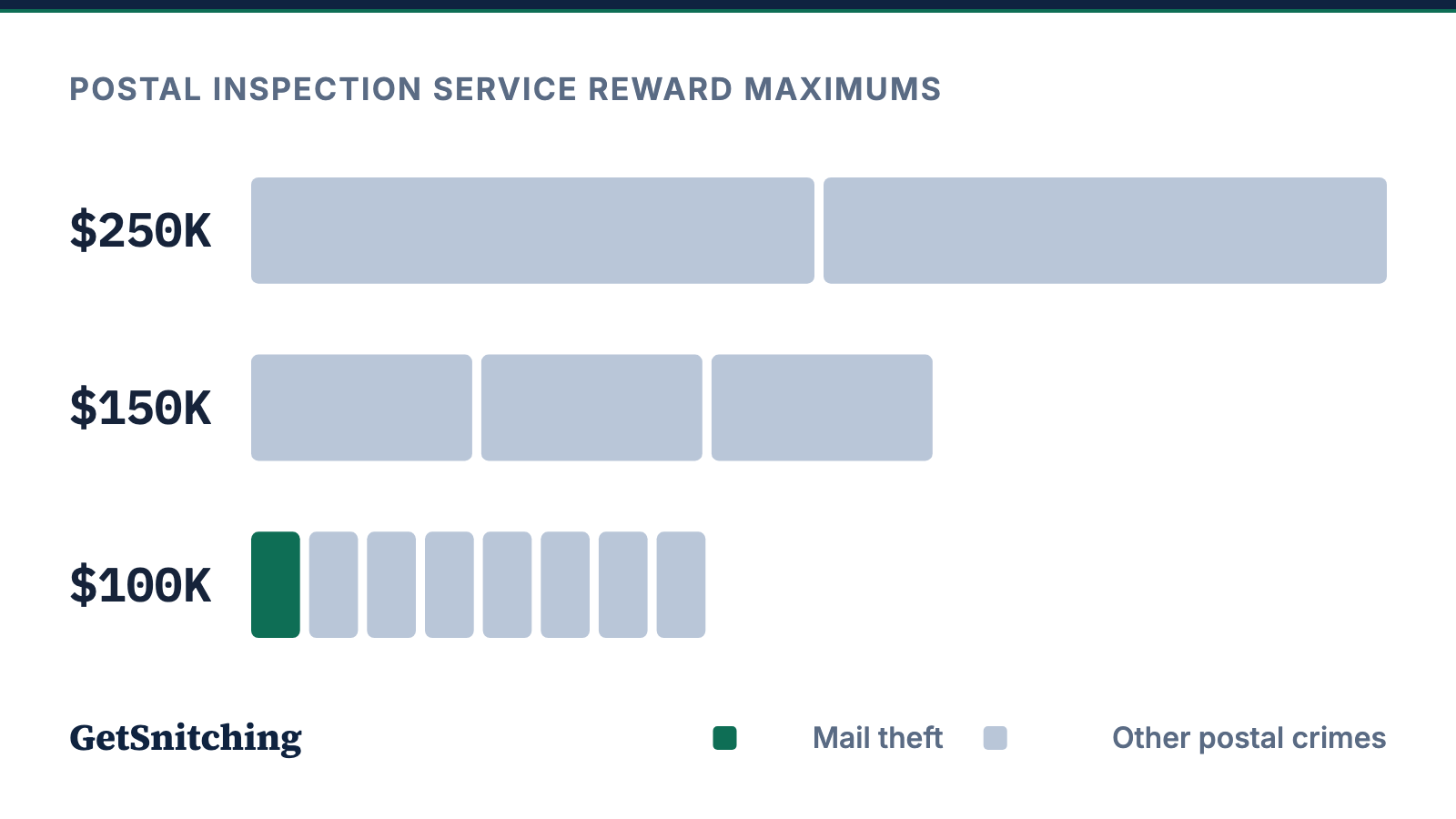
Mail theft is one line on a longer list. These are the maximums on the April 2025 notice:
| Offense | Up to |
|---|---|
| Murder or manslaughter of a postal employee or contractor | $250,000 |
| Mailing bombs, explosives, or poisons | $250,000 |
| Robbery or attempted robbery of a custodian of the mail, such as a letter carrier | $150,000 |
| Assault on a postal employee | $150,000 |
| Use of the mail for the sexual exploitation of children | $150,000 |
| Theft of mail or Postal Service property | $100,000 |
| Burglary of a post office | $100,000 |
| Mail fraud | $100,000 |
| Theft or forgery of postal money orders | $100,000 |
| Postage or meter tampering, including counterfeit stamps | $100,000 |
| Mailing controlled substances or firearms, or using the mail for money laundering | $100,000 |
| Workers’ compensation fraud by a current or former postal employee | $100,000 |
The same amounts apply to information about accessories, people holding property stolen in these crimes, and conspiracies to commit them. The Postal Inspection Service’s Project Safe Delivery page describes these as increased rewards under an updated reward program, so older posters and articles may show lower figures.
What this means in practice
A reward is tied to helping solve a crime, not to being a victim of one. If your mail was stolen, report it so inspectors can connect it to other thefts. A report with no information about who did it does not fit the terms of the notice.
The information that fits the notice is information that identifies a person: who robbed a carrier, who is breaking into collection boxes, who is selling stolen checks or postal keys. The notice asks for information. It does not ask anyone to follow or confront a suspect. For a crime in progress, call 911.
Do not report someone you only suspect as though you know. An arrest and a conviction rest on evidence, so say what you saw and how you know it.
How to report
- Mail theft and other mail crimes: the Postal Inspection Service, online at uspis.gov/report or by phone at 1-877-876-2455.
- A crime in progress: 911.
- A postal employee or contractor stealing mail: the USPS Office of Inspector General, a separate office with its own hotline. The reward notice covers crimes the Postal Inspection Service investigates.
Our page on reporting mail theft and mail fraud explains which office handles what. A person who wants a reward has to file a written claim, which means identifying yourself to a postal inspector. If you want your name kept out of it, read how to report fraud anonymously first.
Not legal advice
GetSnitching explains programs and processes in plain English from official sources. Whistleblower and reporting decisions can carry real legal risk. For advice about your situation, talk to a licensed attorney. Many whistleblower attorneys offer free consultations.
Official sources
- Notice of Reward, Poster 296, April 2025 (U.S. Postal Inspection Service)
- Report a Crime, including the Notice of Reward (U.S. Postal Inspection Service)
- 39 U.S.C. 404, Specific powers of the Postal Service (rewards at 404(a)(7))
- Project Safe Delivery (U.S. Postal Inspection Service)
- Hotline (USPS Office of Inspector General)