Does NHTSA pay auto safety whistleblowers? Yes, 10 to 30%
Verified against official sources:
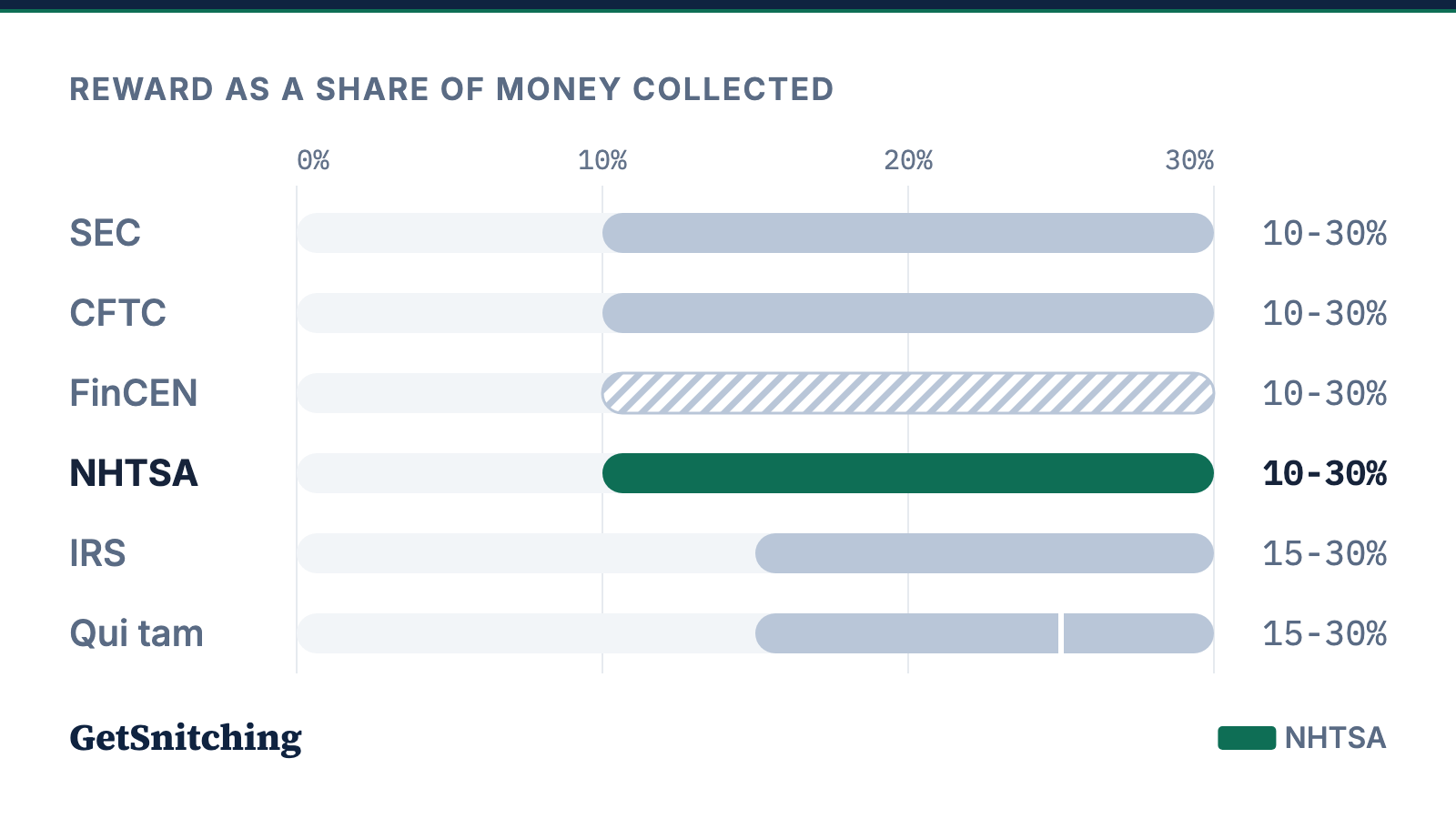
Yes, for a narrow group of people. Federal law lets the National Highway Traffic Safety Administration pay a whistleblower 10 to 30 percent of the money the government collects when the whistleblower’s information leads to an enforcement action with more than $1 million in sanctions. The law limits this to employees and contractors of a motor vehicle manufacturer, a parts supplier, or a dealership. A car owner who reports a defect is not eligible for an award, and the law says NHTSA “may” pay, not that it must. Here is what the statute, the rule, and NHTSA’s own page say.
What the law pays
The statute is 49 U.S.C. 30172, part of the 2015 highway law. Its terms:
- The threshold. A “covered action” is an enforcement action, with any related actions, that results in monetary sanctions “exceeding $1,000,000” in total.
- The range. If a whistleblower’s original information leads to the successful resolution of a covered action, NHTSA may pay one or more whistleblowers a total of not less than 10 percent and not more than 30 percent of the collected monetary sanctions.
- Collected, not announced. The award is paid out of sanctions the government has actually collected.
- Discretion. Whether to make an award, to whom, and in what amount is in the agency’s discretion within that range. A decision can be appealed to a federal court of appeals within 30 days.
Who counts as a whistleblower
The statute defines a whistleblower as “any employee or contractor of a motor vehicle manufacturer, part supplier, or dealership” who voluntarily gives NHTSA original information. The rule at 49 CFR Part 513 adds that this covers people presently or formerly employed, and present or former contractors.
The information must relate to a motor vehicle defect, a failure to meet a federal safety standard, or a violation of a notification or reporting duty, and it must be a problem “likely to cause unreasonable risk of death or serious physical injury.”
That leaves out most people who notice a safety problem: owners, drivers, independent mechanics, insurers, and reporters. They can and should still report, but there is no award for them. See the last section.
What can cost an insider the award
The statute bars an award to a whistleblower who:
- is convicted of a crime related to the action;
- deliberately caused or substantially contributed to the violation, acting without direction from the company;
- repeats facts another whistleblower already submitted;
- does not submit the information in the form the rule requires; or
- skipped the company’s internal reporting channel, where one exists to protect employees from retaliation. This bar does not apply if the person reasonably believed reporting inside would lead to retaliation, reasonably believed the company already knew, or NHTSA waives it for good cause.
A knowingly false statement also ends eligibility and can be prosecuted.
Has NHTSA ever paid one?
Yes. NHTSA’s whistleblower page lists one award decision as of November 9, 2026: on November 5, 2021, it awarded $24,300,000, which it states was 30 percent, to a whistleblower who gave it information related to Hyundai and Kia’s violations of the Safety Act. The underlying consent orders concerned untimely recalls of over 1.6 million vehicles with Theta II engines. No other award is listed on that page.
One award in the life of a program is not a basis for expecting payment. Most reports do not lead to a covered action at all.
The forms and the deadline
NHTSA’s rule was published in December 2024. It requires a tip to be submitted on a WB-INFO form, signed under penalty of perjury, to the Office of the Chief Counsel by email at NHTSAWhistleblower@dot.gov. Information sent after December 4, 2015 and before January 16, 2025 is treated as meeting that requirement. A person may submit anonymously only through a legal representative.
When a covered action is resolved and more than $1 million has been collected, NHTSA posts a Notice of Covered Action. A claim on the WB-AWARD form must be filed within 90 calendar days of that notice.
One thing to know: when we read it, NHTSA’s program page still said there was “no required form” for a submission or an award request. The regulation is the binding text and it names both forms, which are printed as appendices to Part 513. Our NHTSA whistleblower program page walks through the process step by step.
Protect yourself first
A separate law, 49 U.S.C. 30171, bars manufacturers, parts suppliers, and dealerships from firing or otherwise punishing an employee for reporting a defect or violation. A retaliation complaint goes to the Secretary of Labor, through OSHA, and must be filed within 180 days of the retaliation. This protection does not depend on qualifying for an award. See our page on the motor vehicle safety retaliation law.
The award statute also bars the Department of Transportation from disclosing information that could reasonably be expected to reveal a whistleblower’s identity, with limited exceptions such as a public proceeding or the whistleblower’s written consent.
If you are a car owner
You can report a vehicle or equipment safety problem to NHTSA online through its Report a Safety Problem page, or by calling its hotline at 888-327-4236. It pays nothing. It is how a defect an owner notices reaches the agency that can open an investigation or order a recall.
If a company hid a defect from investors, the SEC whistleblower program may apply. If a company billed the government for vehicles or parts it knew were defective, a False Claims Act case is the route that can pay.
Not legal advice
GetSnitching explains programs and processes in plain English from official sources. Whistleblower and reporting decisions can carry real legal risk. For advice about your situation, talk to a licensed attorney. Many whistleblower attorneys offer free consultations.
Official sources
- 49 U.S.C. 30172, Whistleblower incentives and protections
- 49 CFR Part 513, Whistleblower Program (eCFR, current through 11/6/2026)
- Whistleblower Program, including Whistleblower Award Decisions (NHTSA)
- NHTSA Publishes Whistleblower Program Final Rule (NHTSA, December 12, 2024)
- 49 U.S.C. 30171, Protection of employees providing motor vehicle safety information
- Report a Safety Problem (NHTSA)